International SEO Is Becoming an Information Management Problem
2026.08.25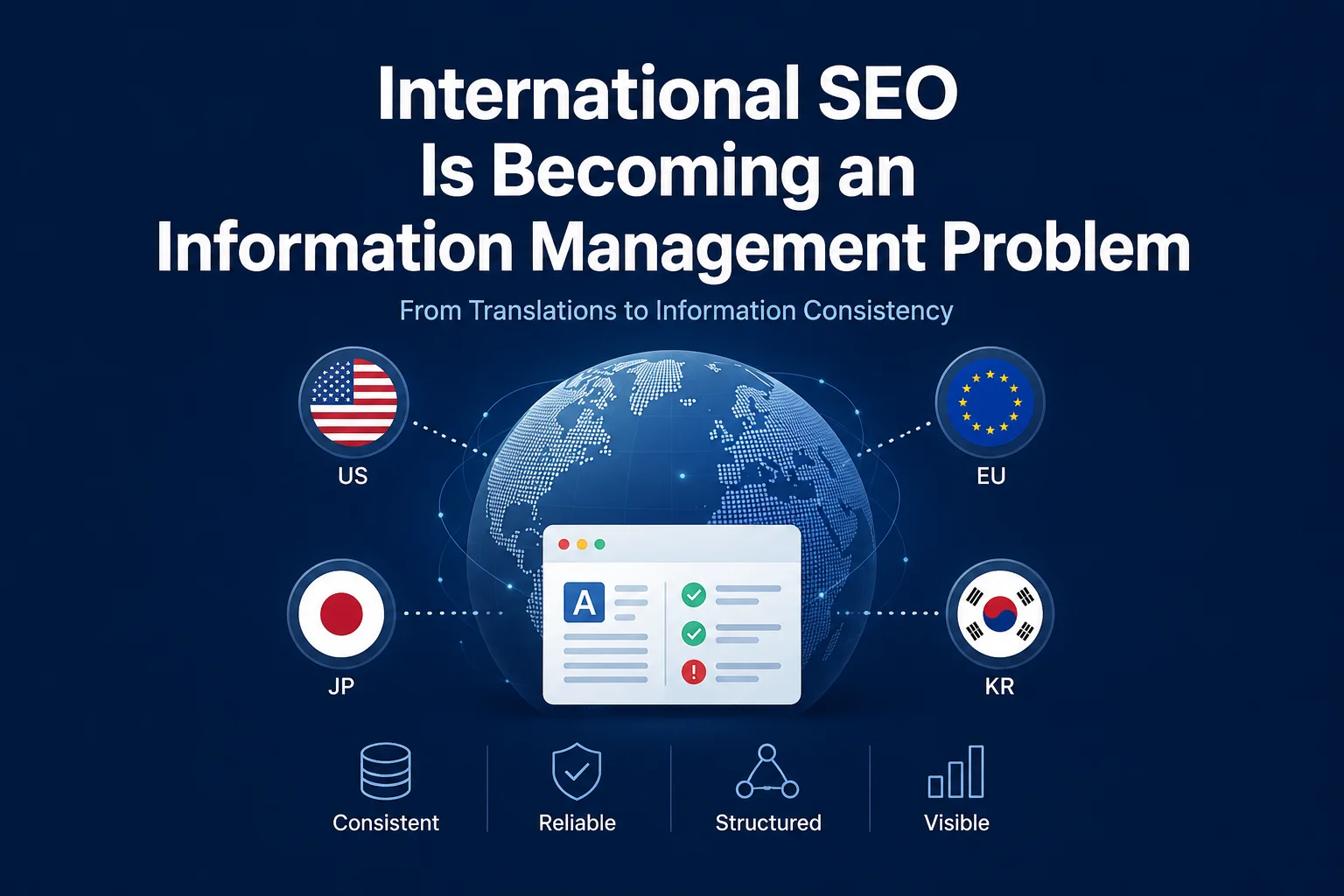
International SEO Is Becoming an Information Management Problem
International SEO used to be discussed mainly in terms of keywords, translated pages, country-specific domains, and hreflang implementation. Those elements still matter. Google continues to recommend separate URLs for language versions and hreflang annotations to help search engines connect users with the appropriate regional or language page. :contentReference[oaicite:0]{index=0}
But the challenge is becoming broader.
A global website may now contain different product specifications, service availability, pricing, policies, contact details, technical documents, and marketing messages across multiple markets. The more the website expands, the harder it becomes to ensure that every market is working with accurate and consistent information.
This changes the role of international SEO.
It is no longer only about helping the right page rank in the right country. It is increasingly about managing the information that represents the business across markets.
01. International SEO Is No Longer Just About Ranking Pages
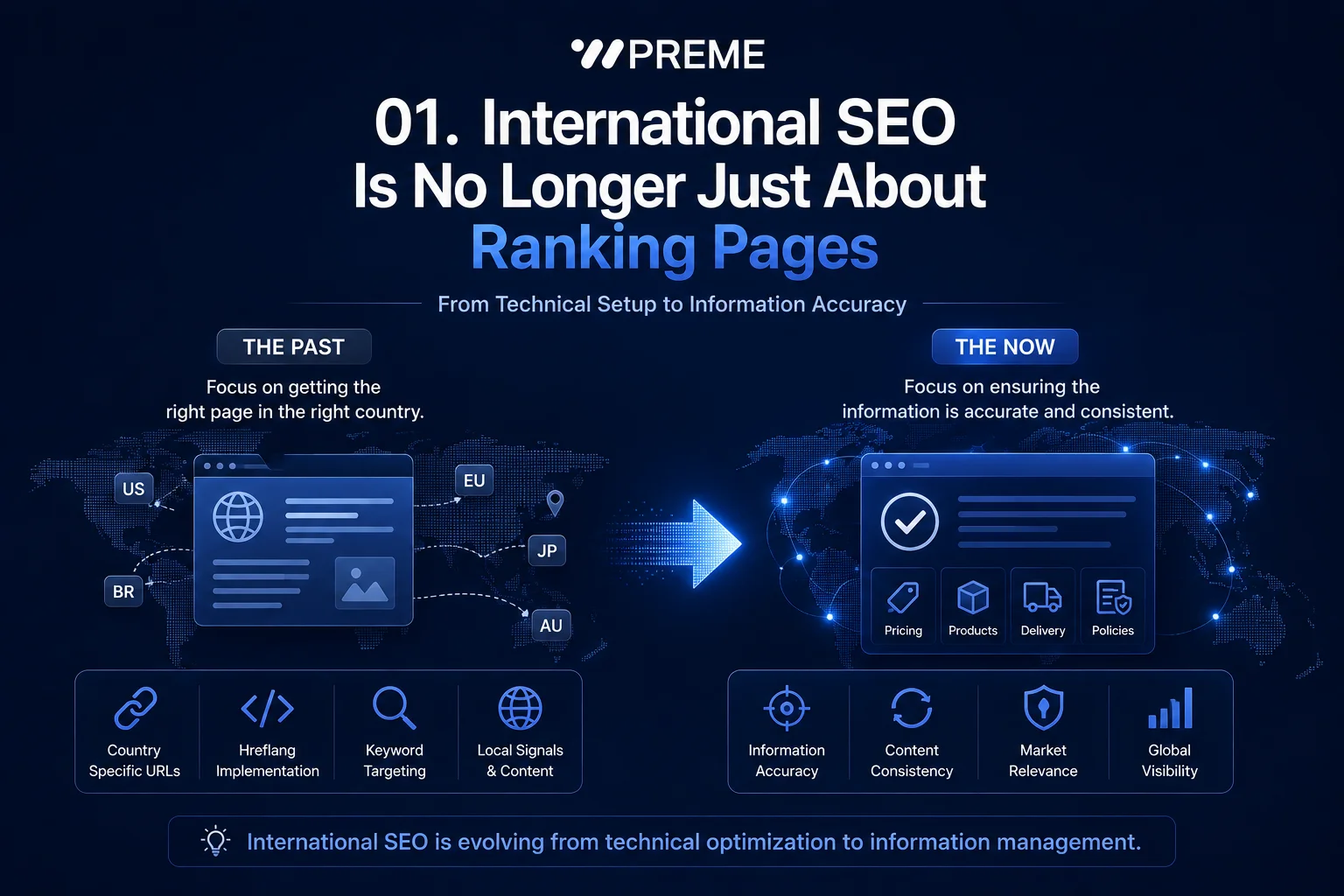
A multilingual website can have a technically correct SEO structure and still create problems.
Separate URLs may be configured correctly. Hreflang may point to the appropriate regional pages. Search engines may be able to crawl each version without difficulty.
Yet the information inside those pages can still be inconsistent.
A product specification may have been updated on the global website but remain outdated on a regional page. A service may no longer be available in one market while the old information remains online. A pricing page may change while an older PDF continues to appear in search.
These are not simply translation problems.
They are information management problems.
Google itself distinguishes multilingual websites from multi-regional websites because different markets may require different content rather than simply another language version of the same page. It also uses multiple signals — including localized content, currency, addresses, links, URLs, and hreflang — to understand the intended audience of a page. :contentReference[oaicite:1]{index=1}
For global businesses, this means SEO has to consider not only where a page should appear, but also whether the information on that page is still correct for the market it represents.
02. One Brand Can Have Multiple Versions of the Truth
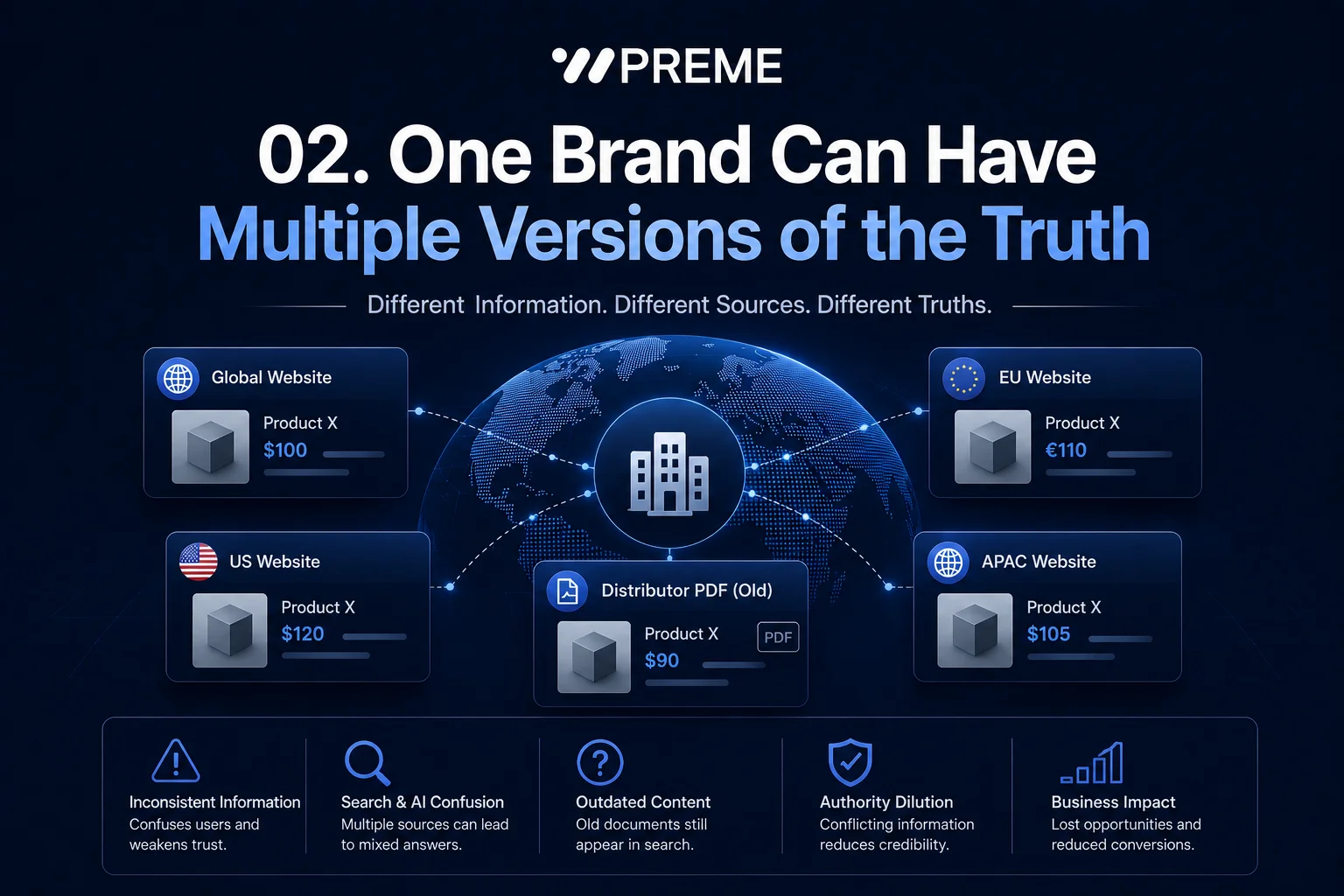
Consider a company operating across several countries.
The global website says one thing.
The US website contains another version.
A European product page was updated six months ago.
A distributor still hosts an older technical document.
A downloadable PDF contains specifications that have already changed.
Each piece of information may have been correct when it was published. The problem appears when all of those sources remain accessible at the same time.
Users can encounter different answers depending on which page they discover.
Search engines can encounter the same problem.
Even technically similar regional pages require careful management. Google recommends canonicalization together with hreflang for similar regional pages in the same language so that it can better understand which regional URL should appear. :contentReference[oaicite:2]{index=2}
Technical signals help search engines understand the relationship between pages, but they do not solve conflicting business information inside those pages.
That requires a different question:
Which source should be considered authoritative when information changes?
For a global website, there should be a clear answer.
03. Localization Now Requires Information Governance
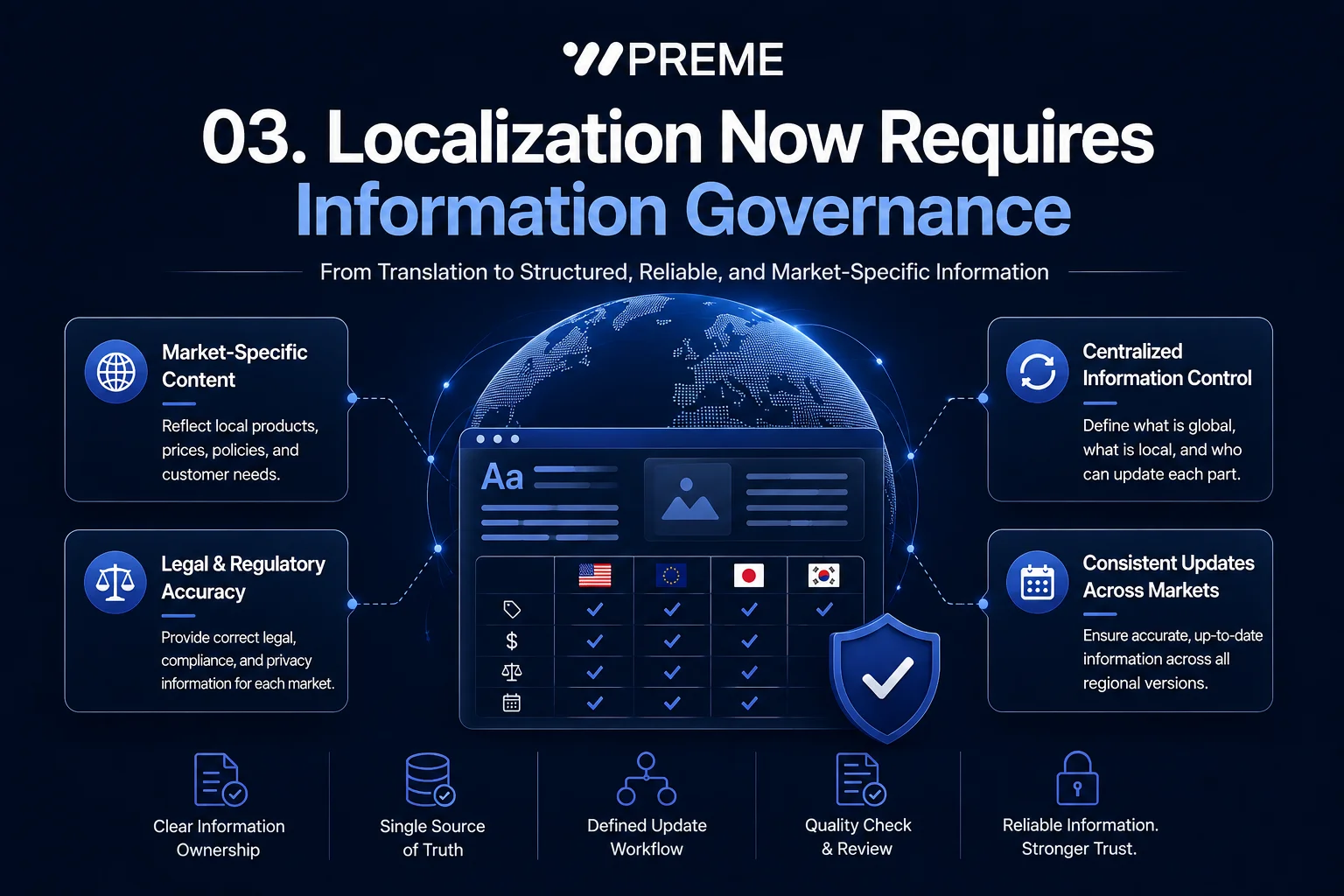
Localization is often treated as the final stage of website production.
Create the primary website, translate the content, publish regional versions, and then maintain them separately.
That model becomes increasingly difficult as the website grows.
A more sustainable approach is to define which information is global and which information is market-specific.
For example:
- Brand positioning may remain globally consistent.
- Product availability may differ by market.
- Pricing and currency are usually regional.
- Legal and regulatory information may require local versions.
- Delivery conditions may differ between countries.
- Contact and support information should reflect the relevant market.
- Technical specifications may require one controlled source across every region.
Once these distinctions are defined, localization becomes easier to manage.
The website is no longer a collection of translated pages. It becomes a structured information system with rules about what can change locally and what must remain consistent globally.
This also reduces technical mistakes.
Google warns that dynamically changing or redirecting content according to perceived language or location can prevent some versions from being fully crawled. Its current guidance continues to favor explicit locale URLs and hreflang annotations for regional and language variations. :contentReference[oaicite:3]{index=3}
Good international SEO therefore requires both technical localization and clear information ownership.
04. Global Visibility Depends on Information Consistency
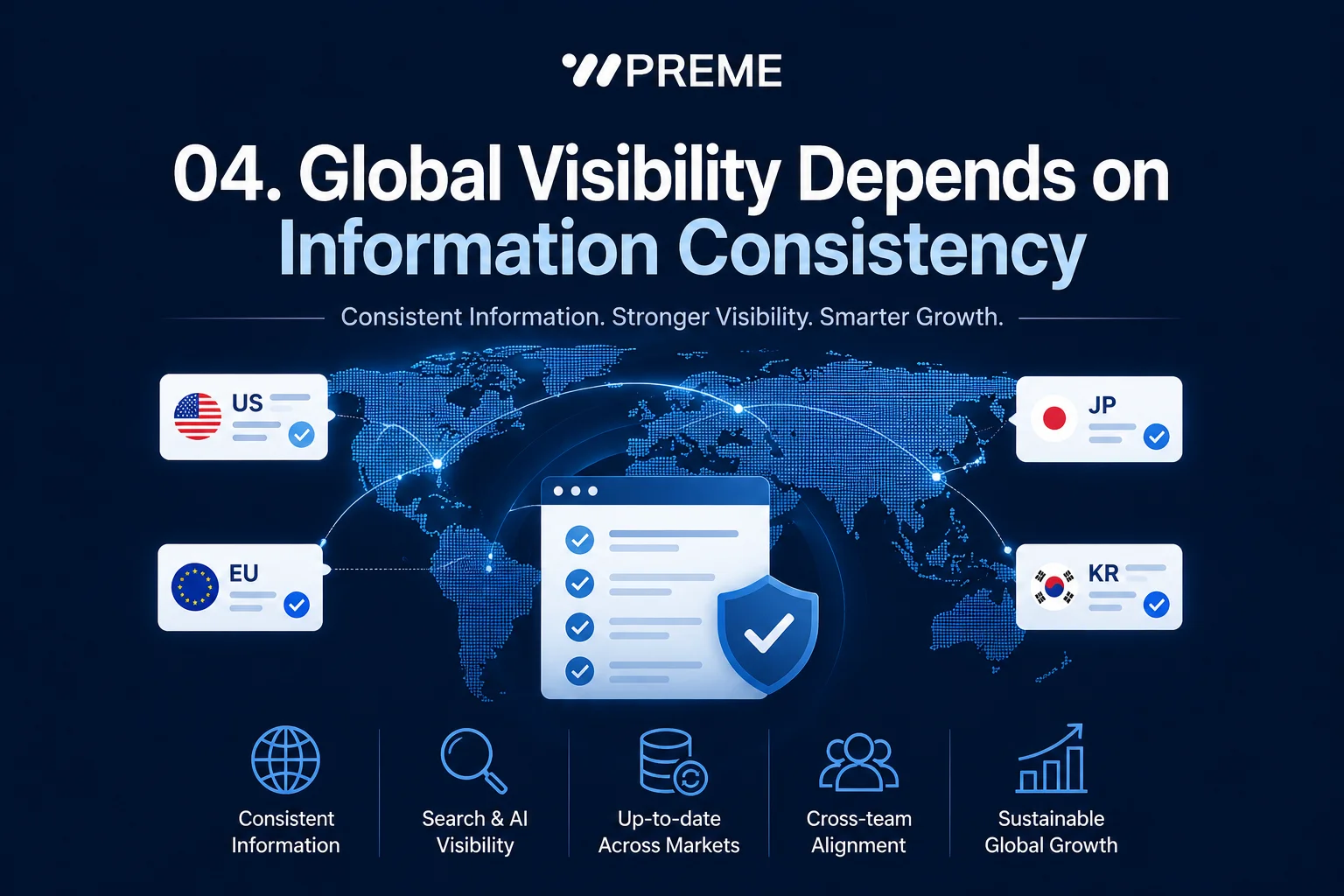
The larger a global website becomes, the more important maintenance becomes.
Publishing another language version is relatively easy.
Keeping ten regional versions accurate for several years is much harder.
This is where businesses need to think beyond individual pages.
There should be a process for determining:
- who owns each type of information,
- which information can be changed by regional teams,
- which information must remain globally consistent,
- when outdated content should be removed,
- how product and service changes are distributed across markets,
- and which page or system acts as the primary source.
Without these rules, international websites gradually accumulate contradictions.
The technical structure matters as well. Google recommends making language and regional variations explicit rather than relying on automatic assumptions, and notes that locale-adaptive implementations may prevent some content from being crawled, indexed, or ranked as intended. :contentReference[oaicite:4]{index=4}
But technical SEO works best when the information behind that structure is already organized.
A perfectly implemented hreflang setup cannot make outdated information accurate.
International SEO Is Becoming Part of Website Operations
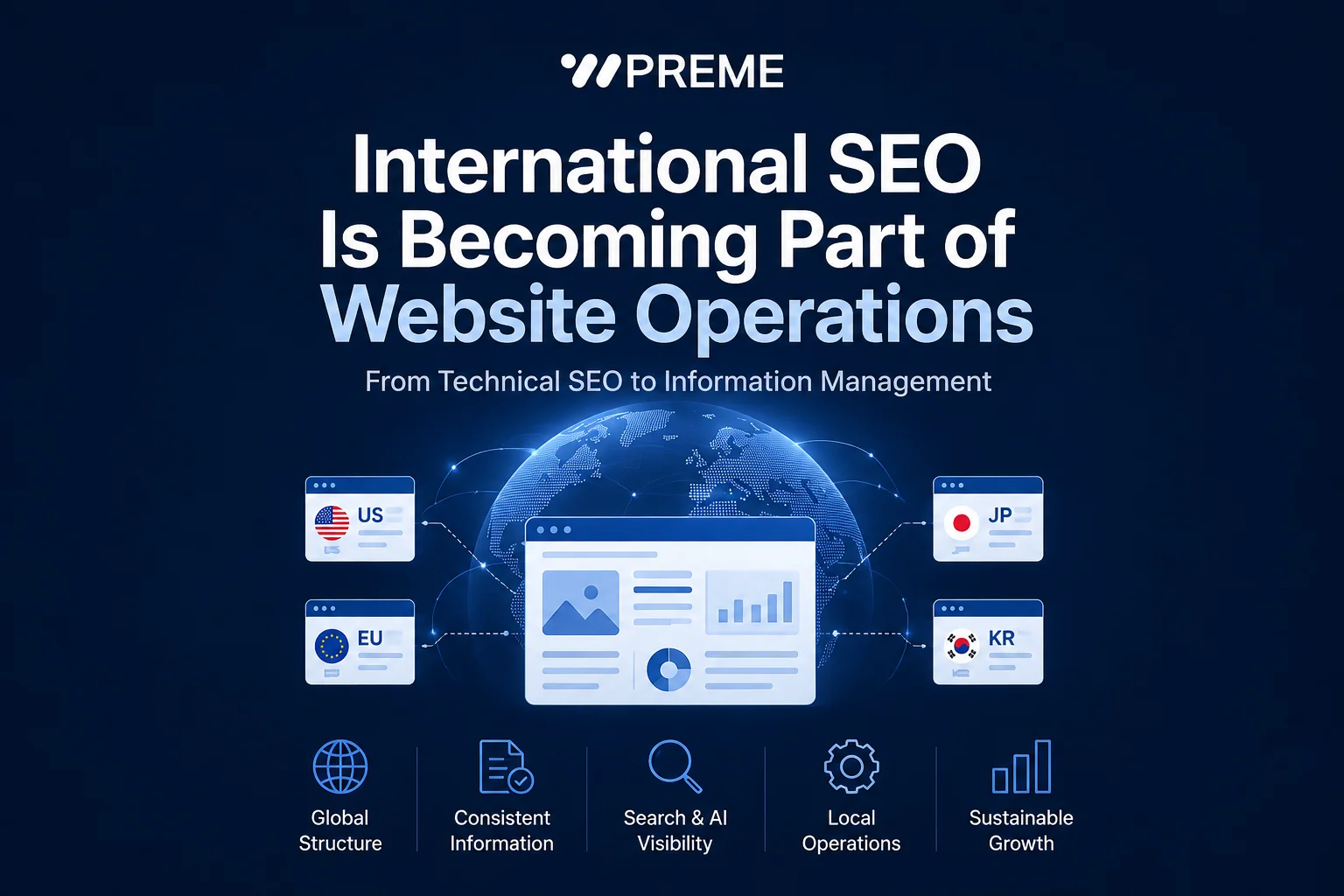
International SEO is not disappearing.
Its scope is expanding.
Keywords, localized URLs, hreflang, canonicalization, technical accessibility, and regional content remain important. But businesses operating across multiple markets also need a system for keeping their information accurate as products, services, teams, policies, and markets change.
That makes international SEO increasingly connected to website operations, content governance, and information architecture.
A global website should therefore be designed not only for launch, but for continuous management.
At WEBPREME, we approach global websites as long-term business infrastructure. The objective is not simply to create multiple language versions of the same website, but to build a structure that can support localized content, market-specific information, technical SEO, and future expansion without losing consistency.
A global website is no longer just a collection of translated pages.
It is becoming the information infrastructure that defines how a business is understood across markets.