A Global Website Needs One Source of Truth
2026.08.26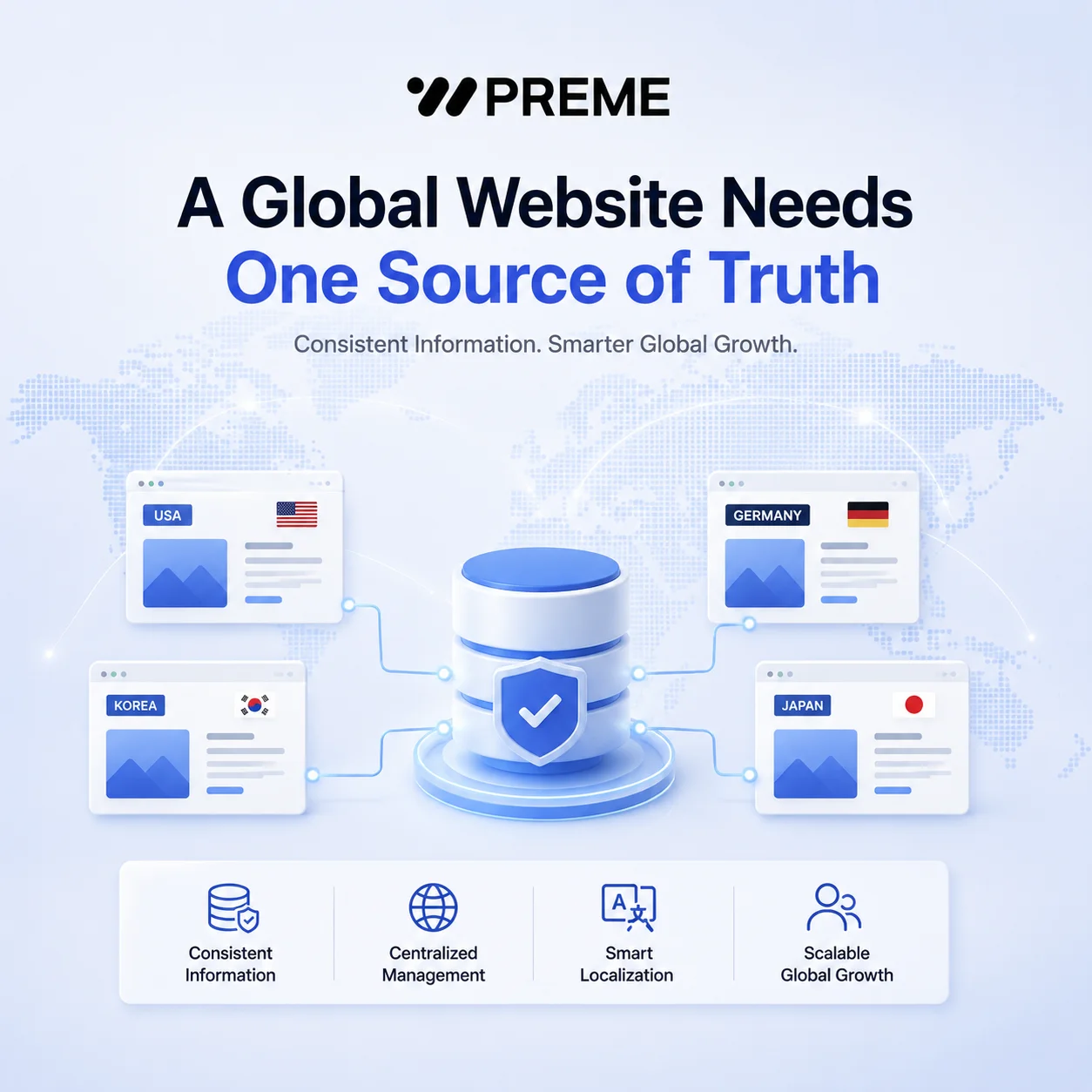
A Global Website Needs One Source of Truth
Managing a global website becomes more complicated as a business expands into new markets. What begins as a single corporate website can quickly grow into multiple language versions, regional pages, product pages, local contact information, and market-specific content.
The challenge is not simply producing more content. It is making sure that every market is working with the same accurate information.
When product specifications change, a certification is renewed, a service is updated, or corporate information is revised, those changes need to reach every relevant version of the website. Without a clear information structure, different markets can gradually begin presenting different versions of the same company.
This is why a global website needs a single source of truth: a reliable foundation that keeps essential information consistent while still allowing each market to localize what needs to be different.
01. Global Websites Often Create Multiple Versions of the Same Information
> INFORMATION FRAGMENTATION > The more independently each market manages content, the easier it becomes for information to diverge.
Headquarters
Corporate information, brand standards, products, services, certifications, and official company data.
Regional Teams
Local campaigns, market-specific services, sales information, and regional announcements.
Local Websites
Translated content, local contact details, case studies, regulations, and customer-facing information.
As these layers grow, information can become fragmented. Headquarters may update a product specification while an overseas website continues displaying the previous version. A regional team may change a service description without that change being reflected elsewhere.
The problem becomes more serious when visitors compare information across different pages. Conflicting specifications, outdated certifications, different company descriptions, or inconsistent service information can reduce trust even when each individual page looks professional.
This is not primarily a translation problem. It is an information management problem.
> KEY INSIGHT > Global consistency becomes difficult when every website manages the same core information independently.
02. One Source of Truth Keeps Global Information Consistent
> CENTRAL INFORMATION > Core business information should have a clearly defined authoritative source.
A single source of truth does not mean that every country website must contain exactly the same content. It means that information that should remain consistent has one reliable reference point.
A practical structure may separate information into several layers:
- Corporate information — company profile, history, brand information
- Product information — specifications, models, technical details
- Service information — capabilities, processes, service scope
- Trust information — certifications, policies, official documentation
- Local information — contact details, local cases, market-specific services
The first four categories may require stronger central control because inaccurate information can affect multiple markets. Local information, on the other hand, may need to be managed directly by regional teams.
When these responsibilities are clearly separated, an update no longer depends on someone remembering every page where the information appears. The website can be managed around the information itself rather than around individual pages.
For a growing international business, this becomes increasingly important because every new market adds another place where outdated or inconsistent information can appear.
> KEY INSIGHT > A single source of truth defines which information is authoritative before deciding how that information appears in each market.
03. Localization Should Adapt Information, Not Recreate It
> GLOBAL CORE / LOCAL CONTEXT > Localization works best when global facts and local communication are managed separately.
Localization is necessary because customers in different markets do not always need the same presentation, examples, terminology, or conversion path. But localization should not require every regional team to rebuild the company’s core information from the beginning.
Consider a manufacturer selling the same product internationally. The technical specifications may remain identical across markets, while units of measurement, regulatory information, applications, downloadable documents, and sales contacts may differ.
The website therefore needs to distinguish between information that is globally fixed and information that can be locally adapted.
Global Core
Product specifications, brand identity, official company information, technical documentation, and other controlled data.
Local Context
Language, market-specific messaging, local regulations, regional case studies, contact methods, and calls to action.
This distinction allows local teams to communicate effectively without creating conflicting versions of fundamental business information.
It also makes future expansion easier. When another country or language is added, the business does not need to recreate every piece of information. The global foundation already exists, and the new market can build its localized experience around it.
> KEY INSIGHT > Effective localization changes how information is communicated without unnecessarily changing the underlying facts.
04. CMS Structure Determines How Global Content Is Managed
> CONTENT GOVERNANCE > Global website architecture should support the way information is actually created, updated, and approved.
A global content strategy becomes difficult to maintain if the CMS treats every language page as an isolated document.
The content management structure should reflect the relationship between global and local information. Certain fields may need to be controlled centrally, while others should remain editable by regional teams. Permissions may also need to differ between headquarters, local administrators, translators, and content managers.
A well-planned global CMS can support:
- Central management of shared company and product information
- Language and market-specific content fields
- Regional editing permissions
- Clear ownership of individual content types
- Structured update and approval workflows
- Easier addition of new countries and languages
This changes website management from a page-by-page process into a structured content operation.
It also reduces the operational burden of expansion. Adding another market becomes less about copying an existing website and more about connecting a new localized experience to an established information system.
For businesses planning long-term international growth, this architecture should be considered during website planning rather than after inconsistencies have already appeared.
> KEY INSIGHT > The CMS should not simply store global content. It should define how that content is shared, localized, updated, and governed.
FINAL NOTE
Global Growth Requires a Reliable Information Structure
A global website is not simply one website translated into several languages. It is an information system that must maintain accuracy across different markets while still giving each region enough flexibility to communicate locally.
As the number of countries, languages, products, and teams increases, managing information manually becomes increasingly difficult. Without a clear source of truth, small inconsistencies can gradually become operational problems.
The goal is not to make every global page identical. It is to establish which information must remain consistent, which information can be localized, and who is responsible for managing each part.
WEBPREME develops global websites with content architecture, localization, CMS management, and future expansion in mind. By establishing a reliable information foundation first, businesses can add new markets without rebuilding their website structure every time.
> WEBPREME INSIGHT > A scalable global website does not create more versions of the truth as it grows. It creates more ways to deliver the same reliable information to different markets.