How to Handle Product Data Across Multiple Country Sites
2026.09.18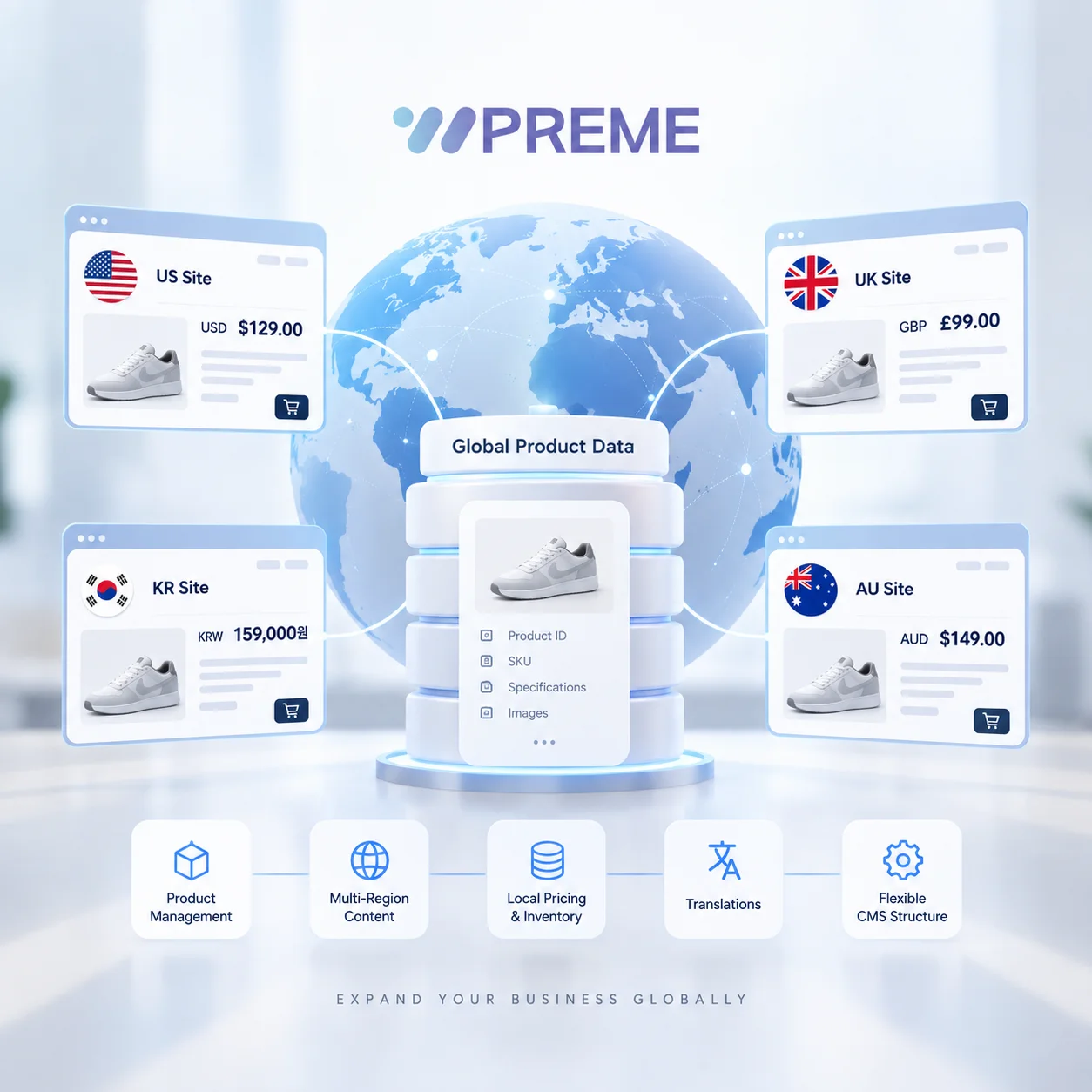
How to Handle Product Data Across Multiple Country Sites
Managing product data across multiple country websites becomes more complex as a business expands internationally.
At first, it may seem efficient to copy the same product information into each regional website and edit the price, language, and availability separately.
That approach can work when only a small number of products or markets are involved.
However, once several countries, languages, currencies, and stock rules are introduced, duplicated product data quickly becomes difficult to maintain.
A better structure separates the information that should remain consistent globally from the information that needs to change by region.
Separate Global Product Data From Local Data
Not every product field needs to be managed separately for each country.
Some information can remain global.
This may include:
- Product ID
- SKU
- Product name
- Main category
- Core specifications
- Technical attributes
- Brand information
Other information may need to vary by country.
For example:
- Local price
- Currency
- Tax
- Stock status
- Shipping availability
- Local product description
- Promotional content
- Legal notices
The important point is to avoid creating completely separate product records when only a few fields actually differ.
A single global product record can act as the base, while regional websites apply local values where necessary.
This makes updates easier and reduces the risk of different country sites showing conflicting information.
Decide Which System Owns Each Type of Data
Product data often exists in more than one system.
The website may contain product descriptions and images, while an ERP manages inventory and pricing. A PIM system may manage product specifications, and a translation platform may store localised content.
Problems start when the same value can be edited in several places.
For example, if stock can be changed in both the website admin and the ERP, it becomes unclear which value should be trusted.
A better approach is to define a source of truth for each type of information.
The ERP may control stock and base pricing, while the CMS controls marketing descriptions and images.
The website then combines those sources when displaying the product.
This type of ownership rule becomes increasingly important as more regional websites are added.
Without it, teams can spend significant time correcting data that has been overwritten or updated in the wrong system.
Handle Regional Differences Without Duplicating Everything
Country-specific product rules should be treated as overrides rather than entirely separate product records where possible.
Imagine the same product is available in Korea, the United Kingdom, and Australia.
The global record may contain the SKU, product images, dimensions, and core specifications.
Each market can then apply its own values for price, tax, availability, and translated content.
A simple structure could look like this:
- Global product data
- Korea-specific values
- UK-specific values
- Australia-specific values
This makes it easier to update shared information once.
If a product image changes, the global record can be updated without manually replacing it across every regional website.
At the same time, local teams can still control the information that genuinely differs by market.
This structure is especially useful when dozens or hundreds of products are distributed across several country sites.
Connect Pricing, Stock, and Content Carefully
Not all product data changes at the same speed.
Marketing copy may remain unchanged for months, while stock can change every few minutes.
This means different types of product data may need different synchronisation strategies.
For example, product descriptions may be updated manually through the CMS, while inventory is synchronised automatically from an ERP or warehouse system.
Pricing may be refreshed periodically, while product availability may need to update almost in real time.
The website should therefore define how frequently each type of data is refreshed.
It should also decide what happens if an external system becomes unavailable.
If the ERP temporarily stops responding, the website should not necessarily stop loading completely.
Depending on the service, it may be better to show the last known value, temporarily disable purchasing, or display an availability notice.
The correct approach depends on how critical the data is.
Build the CMS Around Regional Editing
The CMS should make it clear which information is global and which information is local.
If regional teams cannot easily understand this distinction, they may accidentally overwrite shared product information.
A useful editing structure might show:
- Global fields
- Shared media
- Country-specific content
- Local price
- Local availability
- Local SEO fields
- Publication status by region
Permissions can also be separated.
A headquarters team may control global product specifications, while local teams only edit translated descriptions and regional promotions.
This prevents unnecessary duplication and gives each team access only to the information they actually need to manage.
For larger organisations, approval workflows may also be useful before regional changes are published.
Final Thoughts
Managing product data across multiple country websites is not simply a translation task.
It requires a clear data structure.
The main goal is to keep shared product information centralised while allowing regional websites to override only the fields that genuinely need to change.
A scalable structure usually requires clear rules for:
- Global product records
- Country-specific overrides
- Pricing ownership
- Inventory ownership
- Translation management
- CMS permissions
- Data synchronisation
- External system integration
The more markets a business operates in, the more important these rules become.
Without a clear structure, regional websites can easily drift apart, with different prices, product descriptions, stock information, or outdated content.
With the right architecture, global product data can stay consistent while each country site still reflects its own pricing, availability, language, and business requirements.
Meta Description: Learn how to structure product data across multiple country websites using global records, regional overrides, ERP integration, and scalable CMS workflows.
Meta Keywords: global product data, multi country website, international ecommerce, product data management, ERP integration, global CMS, regional website, ecommerce architecture