How to Choose Between Subdomains, Subdirectories, and Country Domains
2026.09.21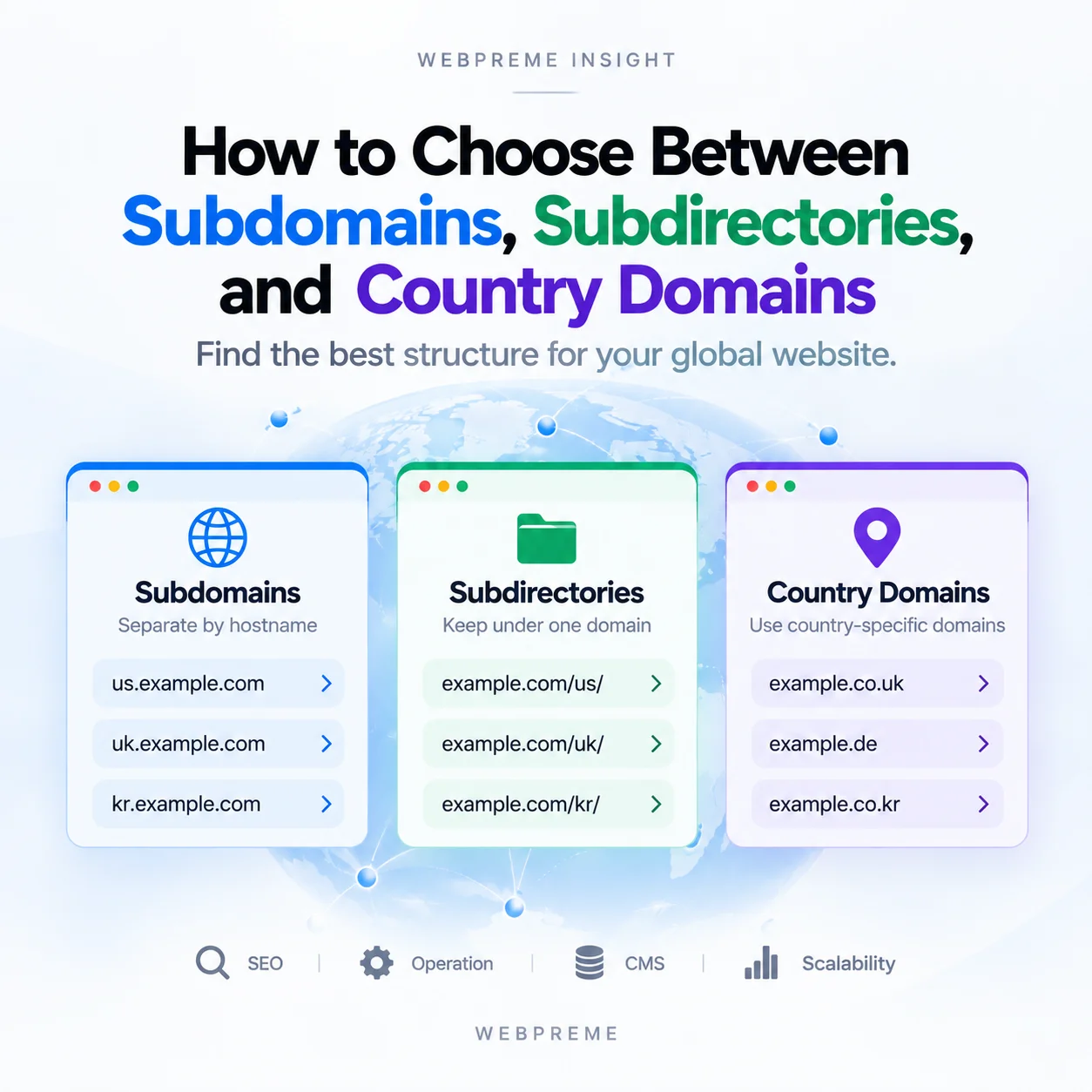
How to Choose Between Subdomains, Subdirectories, and Country Domains
Expanding a website into multiple countries or languages creates an important structural decision: where should each regional version of the website live?
A company might use a subdirectory such as example.com/uk/, a subdomain such as uk.example.com, or a country-specific domain such as example.co.uk.
All three approaches can work. The right choice depends on how independently each market operates, how much content is shared, how the website will be managed, and how important local branding and search visibility are in each country.
Changing this structure later can require URL migrations, redirects, analytics updates, CMS changes, and search engine re-indexing. It is therefore better to decide the structure before a global website becomes difficult to manage.
1. Understand the Difference Between the Three Structures
A subdirectory keeps every regional website under the same main domain.
For example:
example.com/us/ example.com/uk/ example.com/kr/
This structure is common when the company operates one global website and most countries share the same brand, CMS, design system, and technical infrastructure.
A subdomain separates each market at the hostname level.
For example:
us.example.com uk.example.com kr.example.com
Subdomains can provide more technical independence. Different regional websites can use different hosting environments, applications, or development processes while still remaining connected to the main brand.
Country-specific domains use a separate country-code top-level domain, commonly called a ccTLD.
For example:
example.co.uk example.de example.co.kr
This approach creates the strongest separation between markets. It can be useful when each country operates almost like an independent business, but it also creates more domains to maintain.
The decision is therefore not simply about which URL looks better. It affects development, content management, SEO, analytics, infrastructure, and long-term website operations.
2. Use Subdirectories When Markets Share One Website Platform
For many global corporate websites, subdirectories provide the simplest starting point.
The website can use one CMS and one technical platform while separating content by country or language. Global components such as product information, company information, design systems, and navigation can remain centralised.
Regional teams can then manage only the content that differs between markets.
A typical structure might look like:
example.com/us/products/ example.com/uk/products/ example.com/au/products/
This approach can make technical maintenance easier because developers do not need to operate several completely independent websites.
Updates to security, templates, reusable components, analytics, or performance optimisation can often be deployed across all regions at once.
Subdirectories can also make it easier to maintain consistent URLs and internal linking across a global website.
However, the CMS must be designed properly.
Regional editors should not accidentally modify global content, and global administrators should be able to control which content can be overridden locally.
Without a clear permission and content model, a single global CMS can become difficult to manage even if the URL structure itself is simple.
3. Consider Subdomains When Regional Websites Need More Independence
Subdomains become useful when different markets require greater technical separation.
For example, the Korean website might use a local commerce platform while the US website operates on a custom B2B platform.
The company could use:
kr.example.com us.example.com
while maintaining the same parent brand.
This structure allows each regional site to use different hosting, development frameworks, integrations, or deployment schedules.
It can also be useful when regional teams have independent development resources or when a particular market has unique technical requirements.
The trade-off is that operating several subdomains can increase complexity.
Analytics, authentication, cookies, tracking, deployment, monitoring, and content governance may need to work across multiple environments.
Shared website features also become more difficult if each subdomain gradually develops its own technical architecture.
For that reason, subdomains work best when the separation is intentional rather than accidental.
If the regional websites are expected to share almost everything, creating separate subdomains may introduce more operational work than necessary.
4. Use Country Domains When Each Market Operates Almost Independently
Country domains can create a strong local presence.
A business targeting customers in the United Kingdom may use example.co.uk, while its German website might use example.de.
This can make the regional identity of each website immediately clear to users.
Country domains are particularly suitable when pricing, legal requirements, products, customer support, marketing teams, and business operations differ significantly between countries.
However, every domain becomes its own technical property.
That means each one may require separate:
- Domain management
- SSL configuration
- Search monitoring
- Analytics configuration
- Redirect management
- Deployment processes
- Security monitoring
- Content governance
A company operating ten country domains is not simply running one website with ten translations. It may effectively be operating ten separate web properties.
This can be appropriate for large international organisations with independent regional businesses.
For companies that mainly need translated or slightly localised versions of the same website, however, country domains can create unnecessary maintenance.
5. Make the Decision Based on Operations, Not SEO Alone
SEO is important, but it should not be the only factor behind the URL structure.
The more important question is how the organisation actually operates.
If every region uses the same products, branding, CMS, and development team, subdirectories are usually easier to manage.
If regional teams require independent applications or infrastructure, subdomains may provide useful separation.
If each country has its own business organisation, content strategy, legal requirements, and digital operations, country domains may make more sense.
The decision should also consider future expansion.
A website that starts with two markets might eventually support twenty.
If every new region requires a completely separate hosting environment, CMS configuration, analytics property, and deployment workflow, the operational cost can grow quickly.
It is therefore useful to map the structure before development begins:
Global content → Regional content → Language variations → Product differences → Pricing and currency → Local integrations → Regional administrators
Once these relationships are clear, the correct domain structure usually becomes easier to identify.
Technical SEO should then support that architecture through consistent URLs, appropriate redirects, internal linking, hreflang implementation where required, canonical configuration, and region-specific XML sitemaps.
The domain structure and the CMS structure should also match.
If the URL suggests that every country is independent while all regional content is forced through one rigid CMS workflow, website operations can become unnecessarily difficult.
Final Thoughts
There is no single domain structure that is right for every global website.
Subdirectories are often effective when regional sites share one technical platform and central content system.
Subdomains provide more separation when regions require independent infrastructure or applications.
Country domains offer the strongest local separation but also require the most independent management.
The best structure is the one that reflects how content, teams, systems, and regional operations are actually organised.
Before choosing between example.com/uk/, uk.example.com, and example.co.uk, consider not only the launch of the website but also how it will be managed several years later.
A global website should be designed so that new countries, languages, products, and regional requirements can be added without forcing the entire architecture to be rebuilt.