How to Show Certifications and Compliance on a Global Website
2026.10.07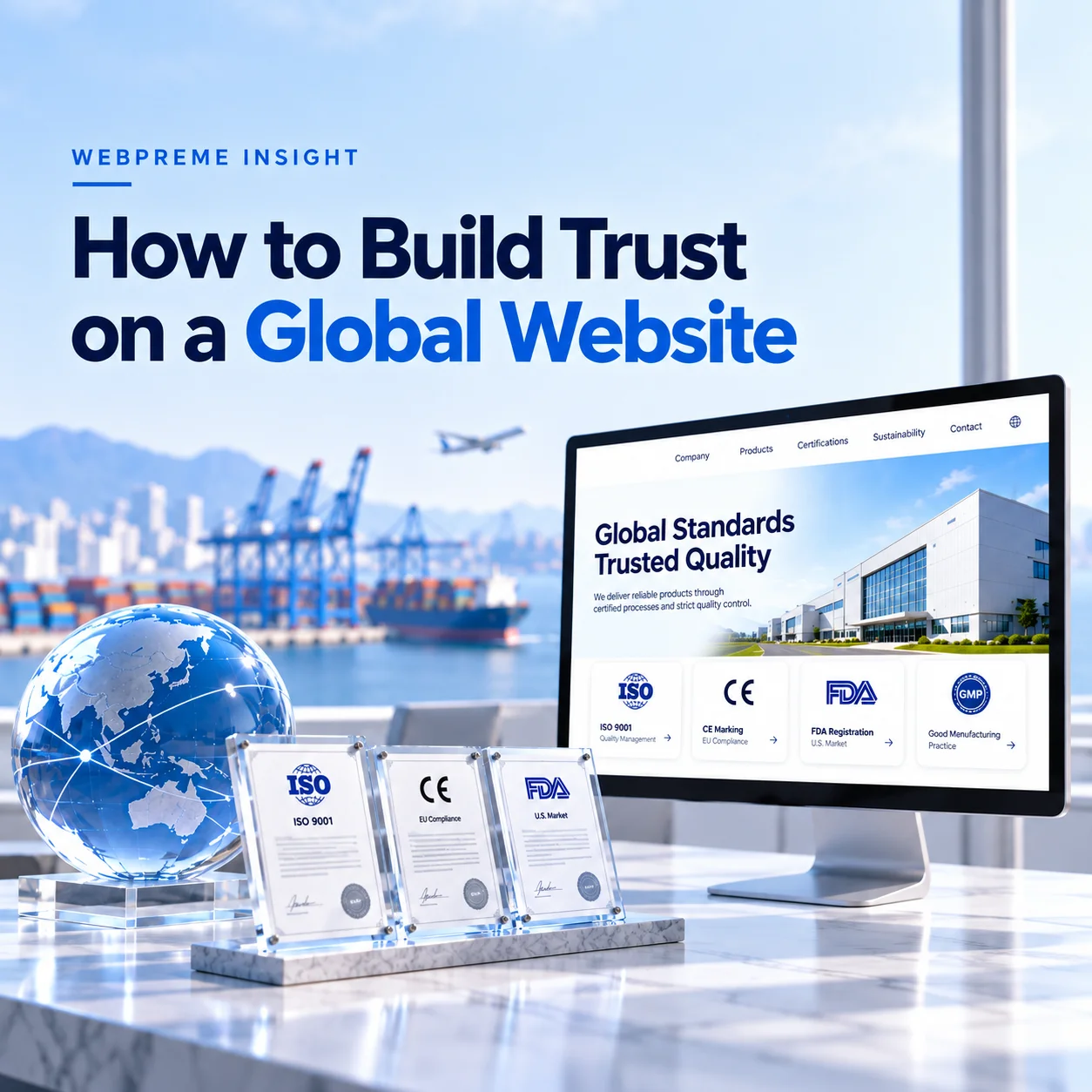
How to Show Certifications and Compliance on a Global Website
For overseas buyers, certifications are not just supporting documents. They are often part of the initial evaluation process.
A buyer may want to know whether a manufacturer follows recognized quality standards, whether a product meets market-specific requirements, and whether the company can provide the documents needed for import or distribution.
This means certifications should not be hidden in a footer, buried in a PDF, or shown only as small logo images.
A global website should present certification and compliance information in a way that is easy to verify and easy to understand.
1. Show Certifications Where Buyers Expect to Find Them
Certification information should be easy to access from relevant pages.
Depending on the business, this may include:
- Company or About page
- Manufacturing or Facility page
- Product detail pages
- Quality or Compliance page
- Download or Technical Documents section
The goal is not to display every certificate in every section.
Instead, place certification information where it helps the buyer make a decision.
For example, company-wide quality certifications may belong on the company or manufacturing page, while product-specific certifications should be connected to the relevant product category.
2. Do More Than Display Certification Logos
A row of certification logos can provide a quick visual signal, but it is usually not enough.
International buyers may need to understand what the certification applies to.
Where appropriate, provide basic supporting information such as:
- Certification name
- Applicable product or facility
- Certification body
- Validity period
- Certificate number
- Available document or verification method
This helps buyers distinguish between a general company certification and a certification that applies directly to the product they are evaluating.
Do not make claims that go beyond the actual scope of the certification.
Clear and accurate information is more useful than simply displaying a large number of logos.
3. Separate Company, Facility, and Product Compliance
One common problem on global websites is that all certifications are grouped together without explanation.
This can create confusion.
A better structure is to separate them by scope.
Company Certifications
These may relate to management systems, quality processes, or organizational standards.
Facility Certifications
These may apply to manufacturing sites, laboratories, production lines, or specific operational environments.
Product Certifications
These may relate to individual products, product groups, safety standards, or market-specific requirements.
This distinction helps overseas buyers understand exactly what has been certified.
It also reduces the risk of a buyer assuming that one certificate applies to every product the company sells.
4. Make Compliance Information Market-Specific When Necessary
Compliance requirements can differ by country and industry.
A certification that is important for one market may not be relevant in another.
For companies selling internationally, it can be useful to organize compliance information by target market or product category.
For example:
- European market requirements
- U.S. market requirements
- Cosmetic product compliance
- Medical or healthcare requirements
- Industrial product standards
- Food or manufacturing-related standards
The website does not need to become a legal database.
Its role is to help buyers quickly understand which standards or certifications may be relevant to their inquiry.
If additional documents are available, the website can direct buyers to request them.
5. Make Supporting Documents Easy to Request or Download
In B2B transactions, buyers may need more than a certification logo.
They may request certificates, test reports, specifications, declarations, or other supporting documents during evaluation.
A global website can make this process easier by providing a clear document flow.
Depending on the company, this may include:
- Downloadable certificates
- Technical document library
- Request document button
- Inquiry form with document type selection
- Product-specific document links
However, not every document needs to be publicly downloadable.
Some companies may prefer to provide sensitive or customer-specific documents after receiving an inquiry.
In that case, the website should clearly explain that supporting documents are available upon request.
Final Thoughts
Certifications and compliance information help overseas buyers reduce uncertainty.
The most effective global websites do more than display certification logos. They explain what is certified, where the certification applies, and how buyers can verify or request supporting documents.
A clear structure can make the difference between a buyer simply seeing a certificate and actually understanding what it means for the transaction.
For manufacturers and B2B companies, certification content should therefore be treated as part of the website's trust structure rather than as a decorative section.
WEBPREME designs global websites around the information overseas buyers need to evaluate a company, including products, manufacturing capabilities, certifications, documentation, and inquiry pathways.