When Does a Business Website Need Custom Functionality?
2026.11.09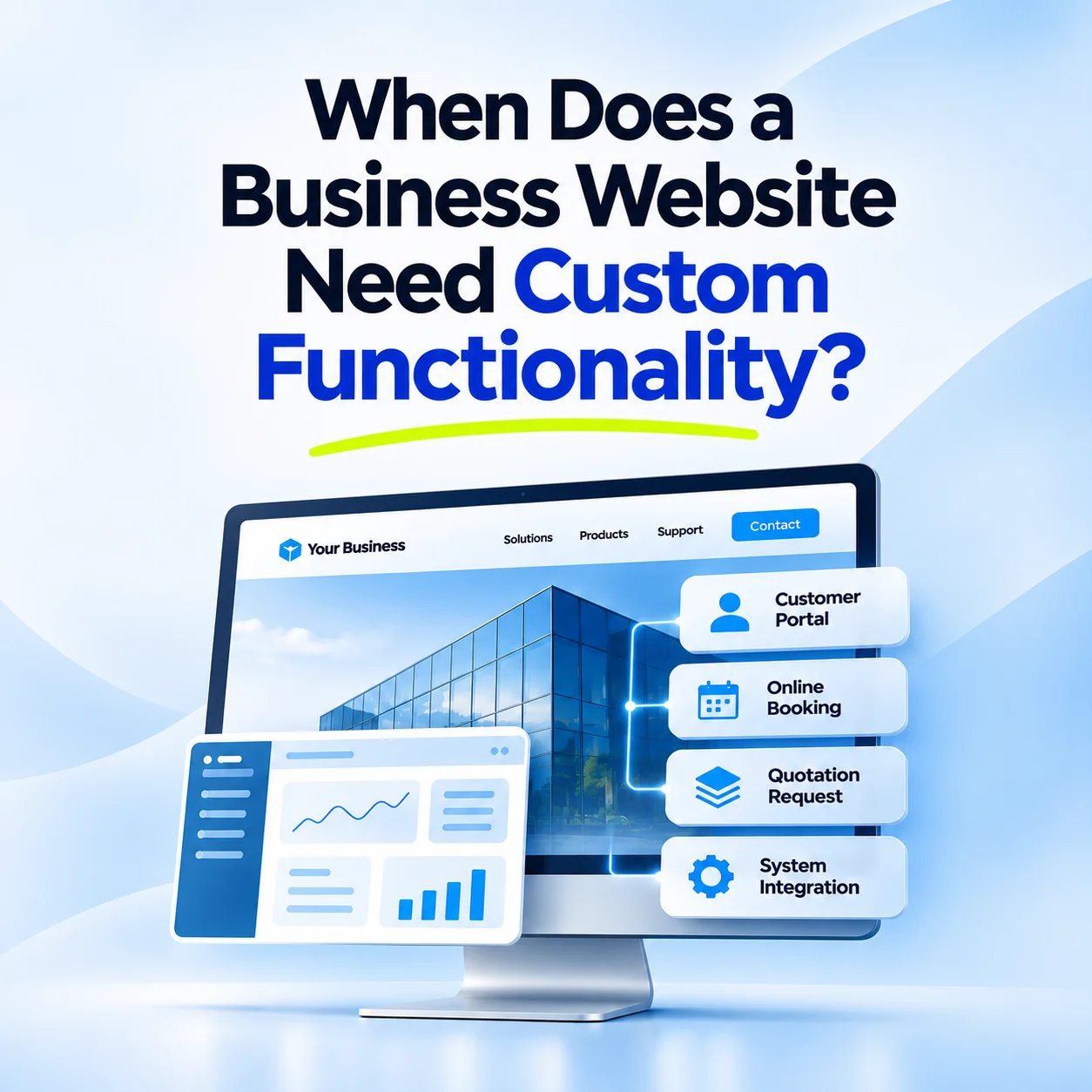
When Does a Business Website Need Custom Functionality?
A business website often starts with a straightforward purpose: introduce the company, explain its services, and make it easy for customers to get in touch.
For many businesses, a standard content management system (CMS) or website platform can handle these requirements effectively.
However, as a company grows, its website may need to do more than display information. It might need to manage customer accounts, process quotation requests, connect with internal software, or support specific operational workflows.
This is where custom website functionality becomes worth considering.
The important question is not whether custom development is better than a standard website. It is whether the business has requirements that existing tools cannot meet efficiently.
1. What Is Custom Website Functionality?
Custom website functionality refers to features developed or configured specifically to support a business's requirements.
A standard business website typically includes common features such as:
- Service and product pages
- Contact forms
- News or blog sections
- Image galleries
- Basic content management
These features are widely supported by existing website platforms.
Custom functionality becomes relevant when a business needs more specialised behaviour.
For example, a wholesale company might need customers to log in and view different product prices based on their account. A service provider might need an enquiry form that automatically assigns requests to different teams.
The distinction is not always between a template and an entirely custom-built website.
An existing CMS can often be extended with custom features without rebuilding the entire platform.
2. When Do Standard Website Features Become Insufficient?
One of the clearest signs is when staff repeatedly perform manual tasks because the website cannot support an existing business process.
Consider a company receiving detailed quotation requests.
A basic contact form may collect a name, email address, and message. However, the business might need customers to select products, specify quantities, upload technical documents, and provide delivery requirements.
In this situation, a structured quotation request system may be more practical than a general enquiry form.
Other examples include:
Customer-specific information
Businesses may need separate account areas where customers can view relevant documents, pricing, or order information.
Advanced product management
Manufacturers and distributors may require technical specifications, product variations, filtering, and downloadable documentation.
Internal approval processes
An application or request might need to move through several approval stages before being completed.
These requirements are not necessarily too complex for an existing CMS. The key is determining whether available extensions can support them reliably.
3. When Should a Business Website Integrate With Other Systems?
Custom website development is often considered when information needs to move between a website and another business system.
For example, a company might already use accounting software, a CRM, an inventory management system, or an ERP platform.
Without integration, staff may need to transfer information manually between systems.
A suitable integration could allow:
- Website enquiries to be recorded in a CRM
- Product availability to be retrieved from inventory software
- Customer requests to appear in an internal management dashboard
- Order details to be transferred to an existing business platform
However, integration is not simply a matter of connecting two applications.
The development team must consider API availability, authentication, data compatibility, error handling, and system permissions.
It is also important to identify which system is responsible for maintaining the correct version of each record.
Before developing a custom integration, businesses should check whether the software providers already offer supported connectors or integration tools.
4. Is Custom Development Always the Right Choice?
Not every business requirement needs a custom-built solution.
Many modern website platforms already support online bookings, e-commerce, membership areas, forms, and integrations through existing features or extensions.
Using a supported solution can reduce initial development work and simplify ongoing maintenance.
Custom development becomes more appropriate when:
- Existing solutions cannot support an essential workflow
- Available tools require too many operational workarounds
- Multiple systems must exchange specific business data
- User roles and permissions require specialised handling
- The business needs functionality that cannot be configured reliably through existing options
Cost should also be evaluated beyond the initial development quotation.
A custom feature may require ongoing maintenance, security updates, testing, and changes when connected services are updated.
For this reason, the most practical solution is often a combination of standard website functionality and carefully selected custom development.
5. What Should Businesses Prepare Before Requesting Custom Development?
Before contacting a website development company, it helps to describe the business problem rather than beginning with a list of technical features.
For example, instead of requesting a custom dashboard, explain who will use it, what information they need, and what actions they must complete.
A useful starting point is to identify:
1. Users: Who needs access to the feature? 2. Workflow: What steps should the user complete? 3. Data: What information needs to be collected, displayed, or updated? 4. Integrations: Does the feature need to communicate with existing software? 5. Administration: Who will manage the feature after launch?
It is also worth identifying what should happen when something goes wrong.
If an enquiry fails to reach an external system, for example, the website should have an appropriate way to record or report the failure.
Clear requirements make it easier to compare development proposals and prevent unnecessary features from increasing project scope.
Final Thoughts
A business website needs custom functionality when its operational requirements extend beyond what standard website tools can reasonably support.
That does not automatically mean replacing the entire website or building everything from scratch.
For businesses in New Zealand and other markets, the better starting point is to examine existing workflows, identify limitations, and determine which features genuinely require additional development.
The goal of custom website development should be to support how the business operates, not simply to add more features.
A well-planned website combines practical functionality, manageable maintenance, and the flexibility to accommodate future business requirements.