Why AI Can’t Recommend Your Business Yet
2026.06.04
Why AI Can’t Recommend Your Business Yet
For years, businesses have focused on one primary goal online: getting found on search engines.
If a website ranked well on Google, most companies assumed their visibility strategy was working. The idea was simple. Someone searched for a service, compared a few websites, and eventually made contact with a business that seemed trustworthy.
That process is changing.
Today, more people are using AI platforms such as ChatGPT, Gemini, and Perplexity before they ever visit a company website. Instead of reviewing multiple search results, users are increasingly asking AI to compare options, explain services, summarize information, and recommend providers.
As AI becomes part of the decision-making process, a new challenge appears.
Your website may rank on Google.
Your website may look professional.
Your website may even attract visitors.
But if AI cannot clearly understand your business, it becomes much harder for AI systems to recommend you confidently.
This is where many businesses are beginning to fall behind.
The future of online visibility is no longer only about being found.
It is also about being understood.
Why AI Struggles to Understand Many Businesses
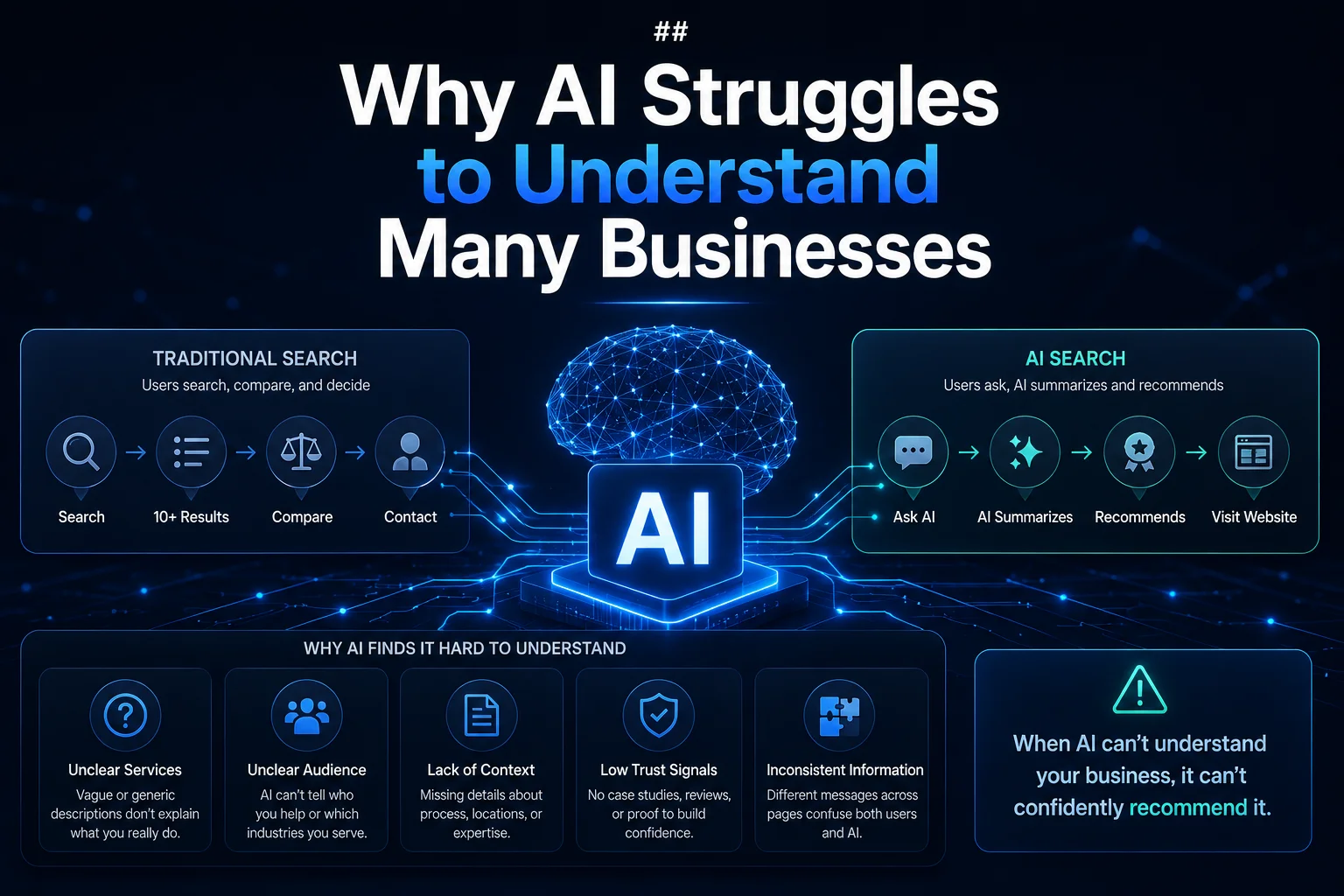
Most business owners assume that if a human visitor can understand their website, AI should be able to understand it as well.
In reality, that is not always true.
AI systems attempt to build a clear picture of a business by gathering information from multiple sources. They look for patterns, context, consistency, and clarity. When users ask questions, AI tries to determine which businesses appear most relevant and trustworthy based on the information available.
The problem is that many company websites are surprisingly difficult to understand.
Some websites rely heavily on marketing language.
Others use industry jargon that means little to people outside the company.
Some provide only short service descriptions and assume visitors already understand what they do.
For example, statements such as "We provide innovative solutions for business growth" may sound professional, but they do not explain much.
What solutions?
For which industries?
For what type of customer?
In which location?
What results can customers expect?
AI systems are asking these same questions.
If the answers are unclear, AI has less confidence in understanding the business correctly.
This becomes particularly important when AI is comparing multiple providers.
Imagine two companies offering similar services.
One company clearly explains its services, target industries, process, locations, and project experience.
The other uses generic marketing language with limited detail.
Both businesses may be capable.
However, AI is more likely to understand and recommend the company that communicates clearly.
The issue is not always expertise.
Often, it is communication.
Many businesses know exactly what they do, but their websites do not explain it clearly enough for either customers or AI systems.
Why SEO Alone No Longer Tells the Whole Story
SEO remains important.
Search engines still need to discover, index, and rank your content.
Businesses should continue following SEO best practices because search visibility is still a major source of traffic.
However, AI search introduces a different layer.
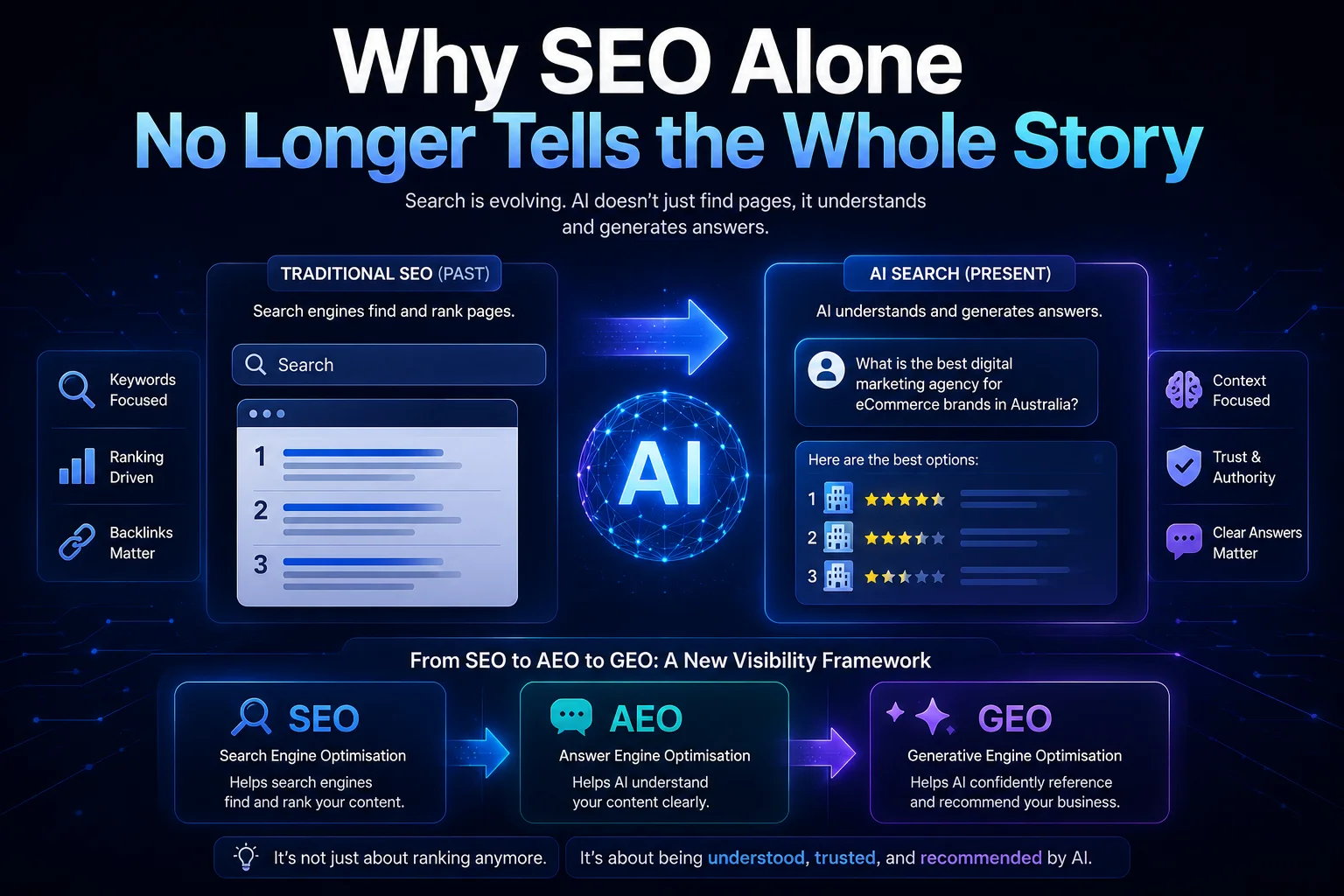
Traditional search engines primarily focus on finding and ranking information.
AI platforms focus on understanding and explaining information.
That distinction matters.
A website can rank reasonably well for certain keywords while still being difficult for AI to interpret.
This is why discussions around AEO (Answer Engine Optimisation) and GEO (Generative Engine Optimisation) have become more common.
SEO helps search engines find content.
AEO helps AI understand content.
GEO helps AI accurately describe and reference content when generating answers.
These approaches work together rather than replacing one another.
Businesses sometimes assume that visual design alone will solve online visibility challenges.
A modern website certainly helps create a positive first impression.
Good design improves trust and usability.
However, visual quality does not automatically create understanding.
A website can look impressive while still failing to explain what the business actually does.
AI does not evaluate websites the same way people admire visual design.
AI looks for context.
It looks for service information, industry expertise, customer relevance, business credibility, and consistency.
If those signals are weak, AI may struggle to identify when the business should appear in a recommendation.
This is why companies should think beyond rankings alone.
Visibility increasingly depends on whether AI can confidently understand and explain the business.
What Businesses Can Do to Become Easier for AI to Recommend
The good news is that becoming easier for AI to understand does not require a complete website redesign.
In many cases, it requires better communication.
Start by reviewing your website from the perspective of someone unfamiliar with your company.
Can they quickly understand what you do?
Can they identify who your services are designed for?
Can they see which industries you work with?
Can they understand the value you provide?
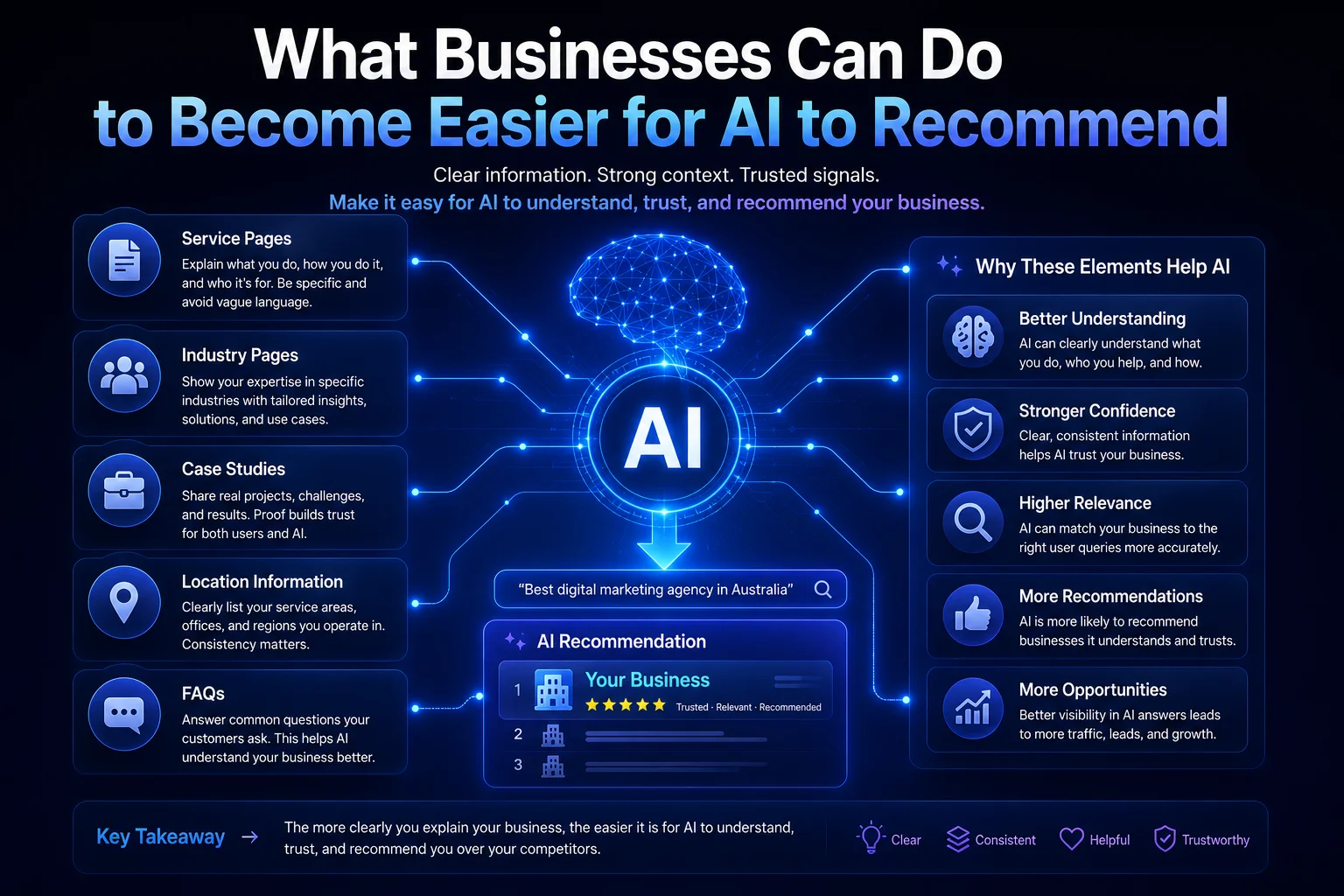
Businesses that perform well in AI-driven environments often share several common characteristics.
They create dedicated pages for individual services.
They publish industry-specific content that demonstrates expertise.
They share case studies that explain real-world projects and outcomes.
They maintain consistent business information across all pages.
They include location information, frequently asked questions, and practical explanations rather than relying entirely on marketing language.
These elements help both users and AI systems understand the business more accurately.
As AI search continues to grow, businesses that communicate clearly will have a significant advantage.
Users increasingly expect direct answers rather than long research processes.
AI platforms are becoming part of how those answers are delivered.
Companies that make their expertise easy to understand will be easier to recommend, easier to trust, and easier to discover.
The future of search is becoming more conversational.
Businesses that prepare for that shift today will be better positioned for tomorrow.
If AI cannot clearly understand your business, it cannot confidently recommend it.
And in a world where more decisions begin with AI-generated answers, that can become a significant competitive disadvantage.
