When Should You Create Separate Pages for Each Market?
2026.08.07
When Should You Create Separate Pages for Each Market?
Expanding into multiple markets often raises a practical website question: should every country see the same pages, or should each market have its own content?
There is no need to create a separate page simply because visitors come from different countries. If the same products, services, purchasing process, and supporting information apply everywhere, maintaining one well-structured page may be more efficient.
The situation changes when customers in different markets need different information to make a decision. Product availability may vary. Certifications may only apply in certain regions. Distribution channels, support options, regulations, and purchasing processes can also differ.
Separate market pages become useful when the information required to evaluate your business changes from one market to another.
The decision should therefore be based on actual business differences rather than geography alone.
Different Markets Often Need Different Information
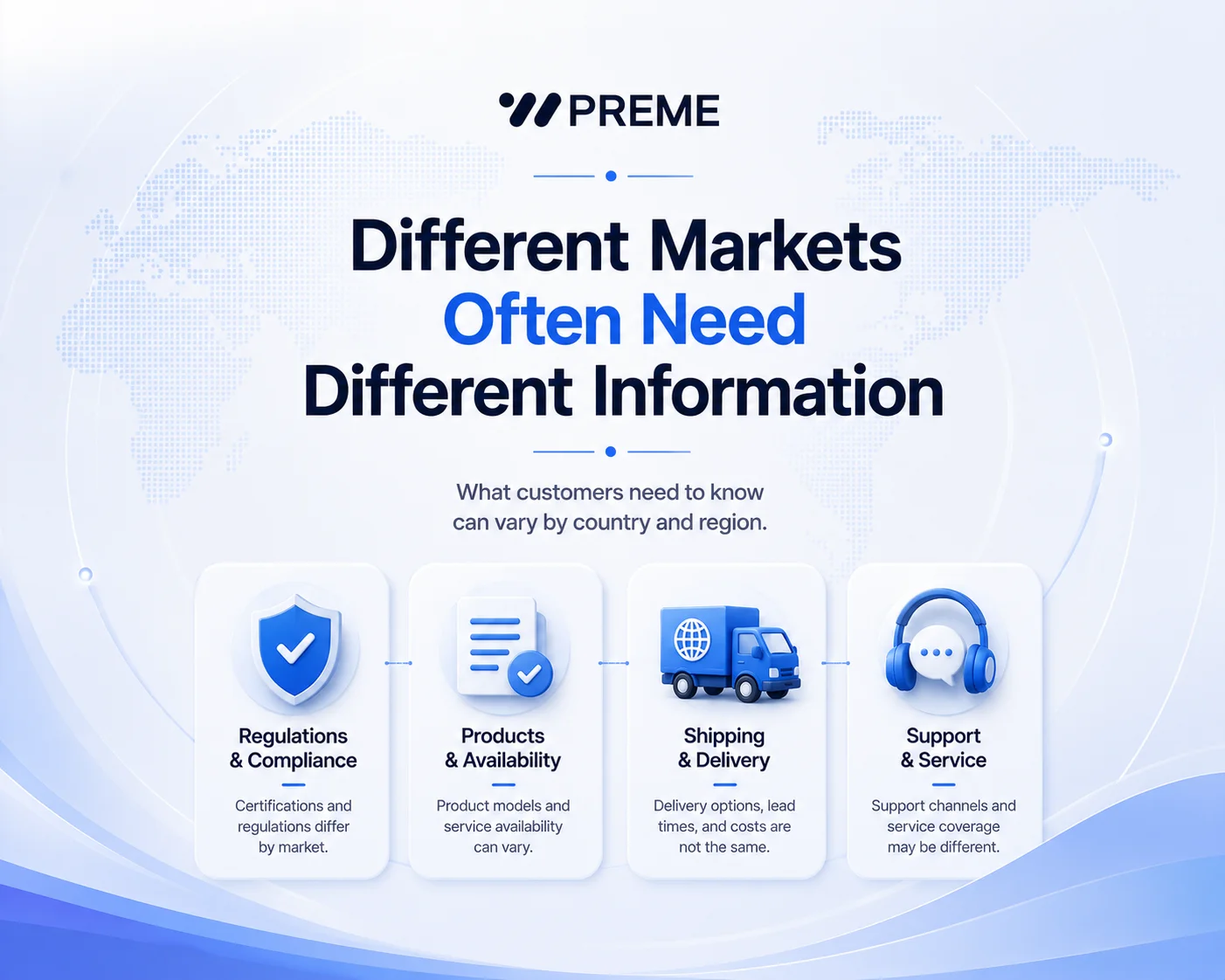
A global customer may be looking at the same company and the same product as a customer in another country, but the questions they need answered can be very different.
A European buyer may need information about regional compliance or certification. A customer in another market may be more concerned about local distribution, delivery availability, technical support, or whether a particular product configuration is available in that country.
If every visitor is directed to one generic page, these differences are difficult to communicate clearly. The page either becomes overloaded with information for multiple markets or remains so general that customers have to contact the company for basic clarification.
Market-specific pages allow businesses to present the information that matters most in each location without rebuilding the entire website.
This does not necessarily mean creating a completely different website for every country. In many cases, a shared global structure with selected market-specific pages is enough.
Create Separate Pages When Your Offering Changes by Market
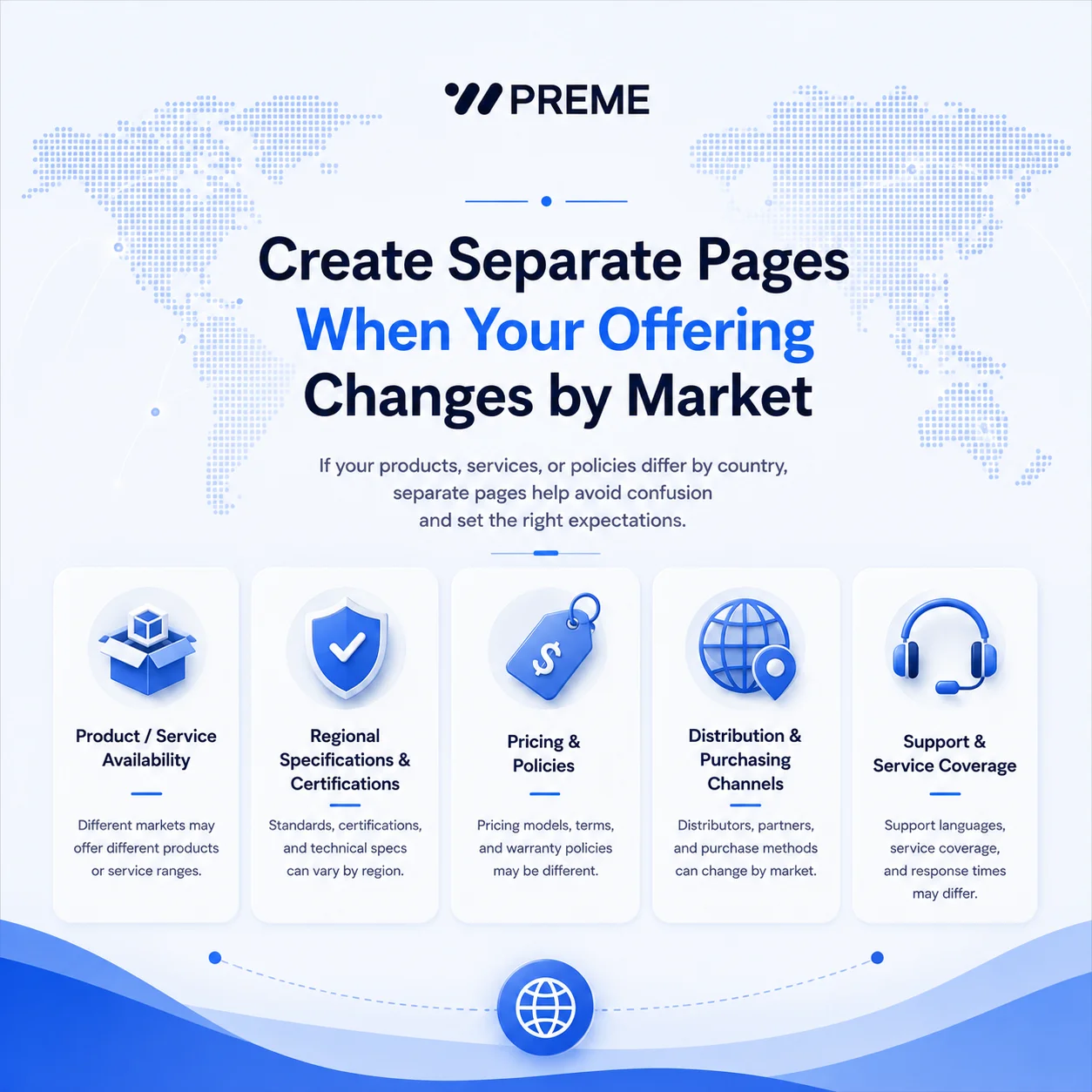
One of the clearest reasons to separate pages is a difference in what the company actually offers.
A manufacturer may sell certain product models only in selected countries. A service company may have different service coverage depending on its local team. Pricing models, warranties, delivery conditions, distributors, and purchasing methods may also vary by market.
In these situations, showing identical information everywhere can create unnecessary confusion.
For example, a visitor may find a product through search, review its specifications, and contact the company only to discover that the model is unavailable in their country. The website generated an inquiry, but it did not help the customer make an accurate decision.
Separate pages become particularly useful when there are meaningful differences in:
Product or service availability Regional specifications and certifications Distribution or purchasing channels Delivery and support coverage Contact points or sales processes
The objective is not to produce more pages. It is to make sure each market receives information that accurately reflects what the business can provide there.
Local Proof Can Make a Global Website More Relevant
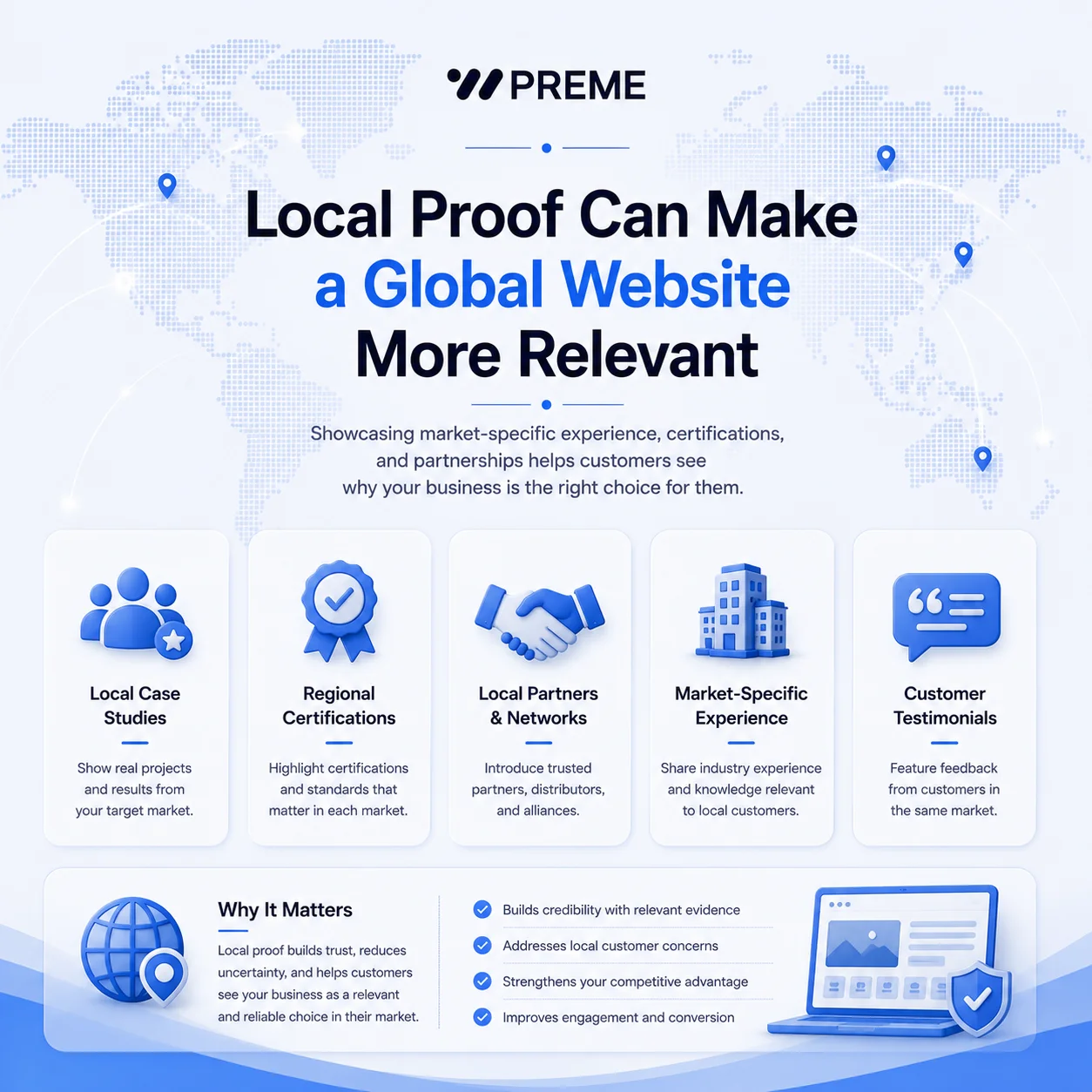
Market differences are not limited to products and services. The evidence customers use to evaluate a company can also change.
A global website may contain strong corporate credentials, international certifications, and major project results. These are valuable, but overseas customers may still want to know whether the company has experience relevant to their own market.
Local project examples, regional partners, market-specific certifications, customer cases, distribution networks, or industry experience can provide that context.
Instead of forcing visitors to search through a global portfolio, a market page can surface the evidence that is most relevant to them.
This is especially useful for B2B companies with long sales cycles or technical products. Buyers often need to confirm not only what a company offers, but also whether it has experience operating under similar market conditions.
However, local proof should be substantive. Creating a country page that simply changes the country name while repeating the same generic company introduction adds little value.
A separate market page should contain information that gives customers a clearer reason to use that page instead of the global version.
Separate Pages Also Need a Clear Management Strategy
Creating separate market pages introduces an operational issue that is easy to overlook: every additional page needs to remain accurate.
Products change. Certifications expire or are renewed. Contact details change. New distributors are appointed. Service coverage expands. Technical documents are updated.
If a company creates pages for ten markets but has no process for maintaining them, visitors may eventually encounter different specifications, outdated documents, or conflicting information depending on which page they open.
Before separating content by market, businesses should therefore consider who will manage each page and how updates will be synchronized with the main website.
A practical approach is to start with markets where the differences are significant enough to justify dedicated content. Other markets can continue using shared global pages until there is enough local information to support a separate experience.
This keeps the website manageable while allowing its structure to evolve alongside international growth.
Creating separate pages for each market is therefore not a requirement for every global website. If the information, offering, proof, or customer journey changes by market, dedicated pages can make those differences easier to understand. If they do not, a shared page may remain the better option.
The right structure is the one that reflects how the business actually operates across markets while keeping information clear, accurate, and maintainable.