What Happens When Product Specs and PDF Catalogs Do Not Match?
2026.10.15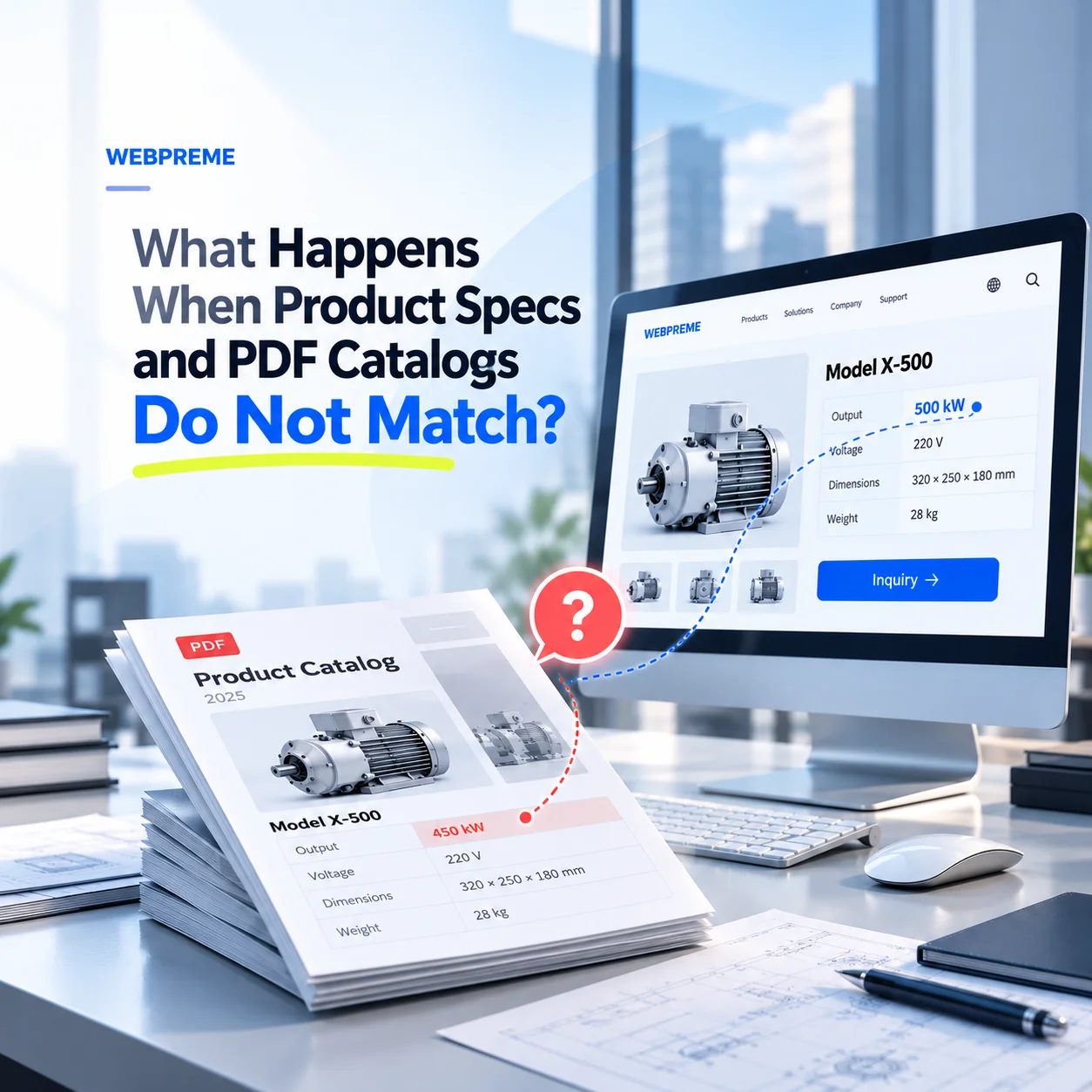
What Happens When Product Specs and PDF Catalogs Do Not Match?
A global website may show one specification while the downloadable PDF catalog shows another.
The difference can be small: a dimension, voltage, material, model number, or available option. However, for an international buyer comparing products remotely, even a small inconsistency can create uncertainty.
The problem is not simply that one file is outdated. It can affect product evaluation, internal sales communication, technical support, and the credibility of the website itself.
1. Buyers May Not Know Which Specification Is Current
When the website and PDF catalog display different information, the first question becomes simple:
Which one should the buyer trust?
A product page may show an updated capacity of 500 units per hour while an older PDF still lists 450. A dimension may have changed after a product revision, but the downloadable catalog may not have been replaced.
The company may know internally which information is correct, but an overseas visitor does not have that context.
This is especially important for technical or B2B products where specifications can influence installation, compatibility, logistics, or purchasing decisions.
The safest structure is to make the current product specification clearly identifiable and prevent outdated documents from appearing as if they are still current.
2. Sales Teams Can End Up Using Different Information
The problem does not remain on the website.
PDF catalogs are often downloaded, emailed, stored locally, and reused by sales teams or distributors. Once an outdated file has been distributed, multiple versions of the same document may continue circulating.
For example:
Product_Catalog_2025.pdf Product_Catalog_Final.pdf Product_Catalog_Updated.pdf
Without a clear document version or revision date, it becomes difficult to know which file should be used.
A global website should therefore treat downloadable documents as part of the company’s information management system, not simply as attachments.
Useful identifiers can include:
- Document version
- Revision date
- Applicable product model
- Language
- Region or market
- Publication status
3. Product Updates Should Be Reflected Across Every Customer-Facing Source
Updating only the website is not enough.
If a product specification changes, every customer-facing source that contains the same information should be reviewed.
This may include:
Product page → PDF catalog → technical data sheet → installation manual → distributor materials
The goal is not necessarily to rewrite every document immediately. The important point is to know which documents are still valid and which ones should be archived or replaced.
For frequently updated products, companies may also choose to keep detailed specifications primarily on the website while using PDFs for more stable information.
This can reduce the number of documents that require repeated updates.
4. Old PDFs Should Not Always Be Deleted
An outdated document is not automatically useless.
Existing customers may still need manuals, specifications, or technical documents for older product generations.
Deleting every previous file can make support more difficult.
Instead, a global website can separate documents into categories such as:
Current Documents Files for products currently being sold.
Archived Documents Files for discontinued or previous product versions.
Archived documents should be clearly labeled so visitors do not mistake them for current specifications.
For example:
Model-A_Specification_v3.2_2026-08.pdf
is much clearer than:
Model-A_spec_final_new.pdf
5. Search Engines and AI Can Also Encounter Conflicting Information
Specification inconsistencies can create problems beyond human visitors.
A product page may state one value while an indexed PDF contains another. Search engines or AI systems may encounter both sources without knowing which one represents the latest information.
This makes clear versioning and page structure increasingly important.
Companies can reduce ambiguity by keeping current product information consistent across major pages, adding revision dates to technical documents, clearly labeling archived material, and avoiding multiple public files that appear to represent the same current product.
The objective is simple:
one product should have one clearly identifiable current source of information.
Final Thoughts
A mismatch between a product page and a PDF catalog may appear to be a minor website management issue, but it can create larger problems for international sales.
Buyers may question which specification is correct, sales teams may distribute different document versions, and older information may continue appearing in search results or AI-generated answers.
Global websites should therefore manage product pages and downloadable documents as one connected information system.
Clear version numbers, revision dates, archive rules, and consistent specifications make it easier for customers, distributors, sales teams, search engines, and AI systems to identify the correct information.
For technical and B2B websites, document consistency is not only a content-management issue.
It is part of how the company communicates accuracy.