What Actually Makes a Website Trustworthy in New Zealand & Australia?
2026.04.20
When businesses invest in a new website, many assume trust comes from visual quality first. A clean layout, modern colours, polished images, and smooth animation are often seen as the main ingredients. Design absolutely matters, but in New Zealand and Australia, trust is usually built faster through clarity, ease of use, and confidence in the business behind the screen.
Many visitors in these markets make decisions quickly. They compare multiple providers, scan websites on mobile devices, and leave fast when information feels unclear. A website may look premium, but if users cannot understand what the company offers within seconds, trust drops immediately.
This is where many business websites struggle. They focus on looking impressive, but forget to feel dependable. In practice, trustworthy websites in NZ and AU are often not the flashiest ones. They are the clearest, simplest, and easiest to act on.
Clear Information Builds Confidence Faster Than Fancy Design
One of the strongest trust signals is immediate understanding.
When someone lands on a homepage, they usually want answers to a few simple questions:
What do you do? Who do you help? Where do you operate? Why should I choose you? How do I contact you?
If those answers are hidden behind vague headlines, oversized banners, or confusing menus, users begin to hesitate.
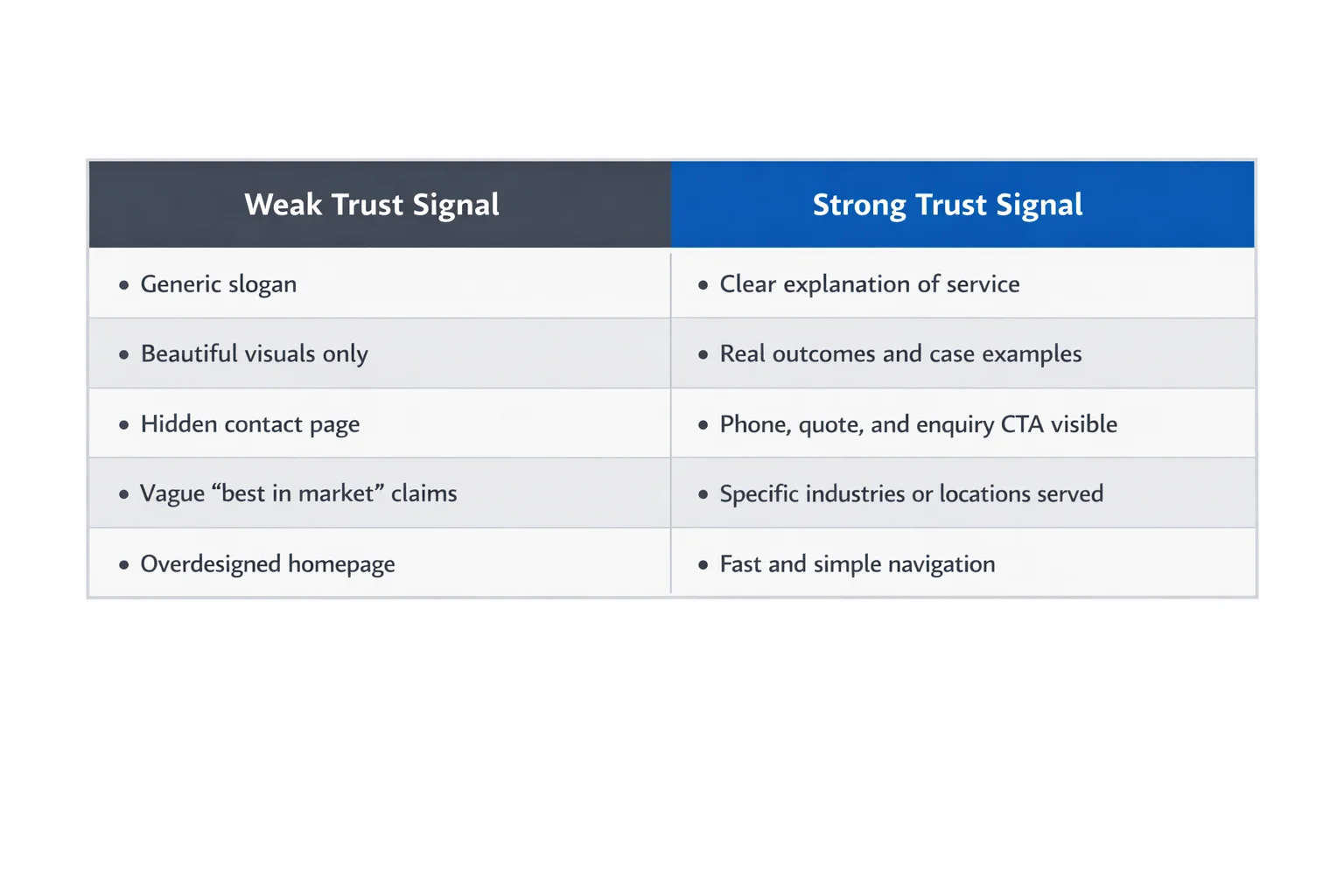
For example, many websites open with lines such as “We Create Better Digital Experiences.” It sounds polished, but it says very little. Compare that with “Commercial Roofing Services Across Auckland” or “Custom Fit-Out Solutions for Melbourne Retail Stores.” The second version builds trust faster because it is specific.
Specific language reduces uncertainty. It tells visitors they are in the right place.
This matters strongly in New Zealand and Australia, where users often prefer practical communication over exaggerated promises. Clear timelines, honest service claims, real experience, and straightforward wording usually perform better than over-marketed statements.
Another important factor is local relevance. If a company serves Christchurch, Wellington, Sydney, Brisbane, or Perth, users often expect to see that clearly mentioned. Service area visibility makes a business feel more real and more reachable.
Trust Is Built Through Experience, Not Just Appearance
A trustworthy website should feel easy to use from the first click.
This is especially important because a large share of traffic in NZ and AU comes through mobile devices. Visitors may be searching while commuting, working onsite, or comparing suppliers quickly during business hours. If the site is slow, cluttered, or difficult to navigate, trust falls before the user reads anything meaningful.
Small usability signals create a big impact:
Fast loading speed Mobile-friendly menus Easy tap-to-call buttons Short enquiry forms Visible pricing guidance or quote options Clear service pages Authentic team or workplace imagery Consistent branding across all pages
None of these are flashy features. But together, they remove friction.
Many businesses underestimate how strongly slow websites affect trust. Users often do not consciously think, “This company seems unreliable.” They simply leave. Delay creates doubt.
Another common issue is hiding contact options. Some websites bury phone numbers in the footer, require multiple clicks to enquire, or only offer a generic email form. In trust-driven markets, accessibility matters. If reaching your business feels difficult, confidence weakens.
Real proof also matters more than decorative claims. Testimonials, certifications, years in business, recognisable clients, before-and-after results, or project photos all help reduce hesitation. Even simple trust markers can outperform expensive visual redesigns.

What Many Businesses Get Wrong About Trust
A common mistake is building websites to impress peers rather than reassure customers.
Internal teams may focus on animation, trendy layouts, or copying competitor websites. But visitors usually care about different things:
Can this company solve my problem? Have they done this before? Are they easy to deal with? Can I trust them with my time and money? What happens next if I enquire?
If the website does not answer those questions quickly, trust weakens.
This is why some average-looking websites generate strong enquiries, while visually polished websites stay quiet. One reassures. The other only decorates.
For service businesses, trust often means reducing risk. A visitor may not need to be amazed. They need to feel safe choosing you.
That can come from clear pricing ranges, realistic project timelines, direct contact pathways, visible credentials, and a homepage message that instantly makes sense.
Businesses entering Australia or New Zealand from overseas sometimes miss this point. They may use a website style that feels corporate elsewhere but too vague locally. Cleaner structure, shorter copy, stronger service positioning, and faster mobile usability often outperform heavier brochure-style websites.
Final Thought
If your website looks modern but still fails to generate quality enquiries, the issue may not be design quality alone. It may be that trust is not being communicated quickly enough.
In New Zealand and Australia, trustworthy websites tend to feel clear, useful, responsive, and honest. They help users understand the offer fast, verify credibility easily, and take the next step without friction.
That is where stronger conversion usually begins.
WebPreme builds websites designed not only to look professional, but to create trust where decisions are actually made.