International Visitors Usually Scan Before They Read
2026.05.14
International Visitors Usually Scan Before They Read
Many businesses assume international website visitors behave the same way local users do.
In reality, the browsing pattern is often very different.
Local users are usually already familiar with the market, business culture, terminology, or service expectations. Even when a website is not perfectly organised, local visitors often have enough context to figure things out on their own.
International visitors usually do not.
This is one of the biggest differences many companies underestimate when building multilingual or overseas-focused websites.
Global users often decide extremely quickly whether a company feels understandable, trustworthy, and operationally stable. They are not necessarily reading every section carefully from top to bottom. In many cases, they are scanning for signals that help them make fast business judgments.
That means the structure of information becomes incredibly important.
International users often prioritise operational clarity first
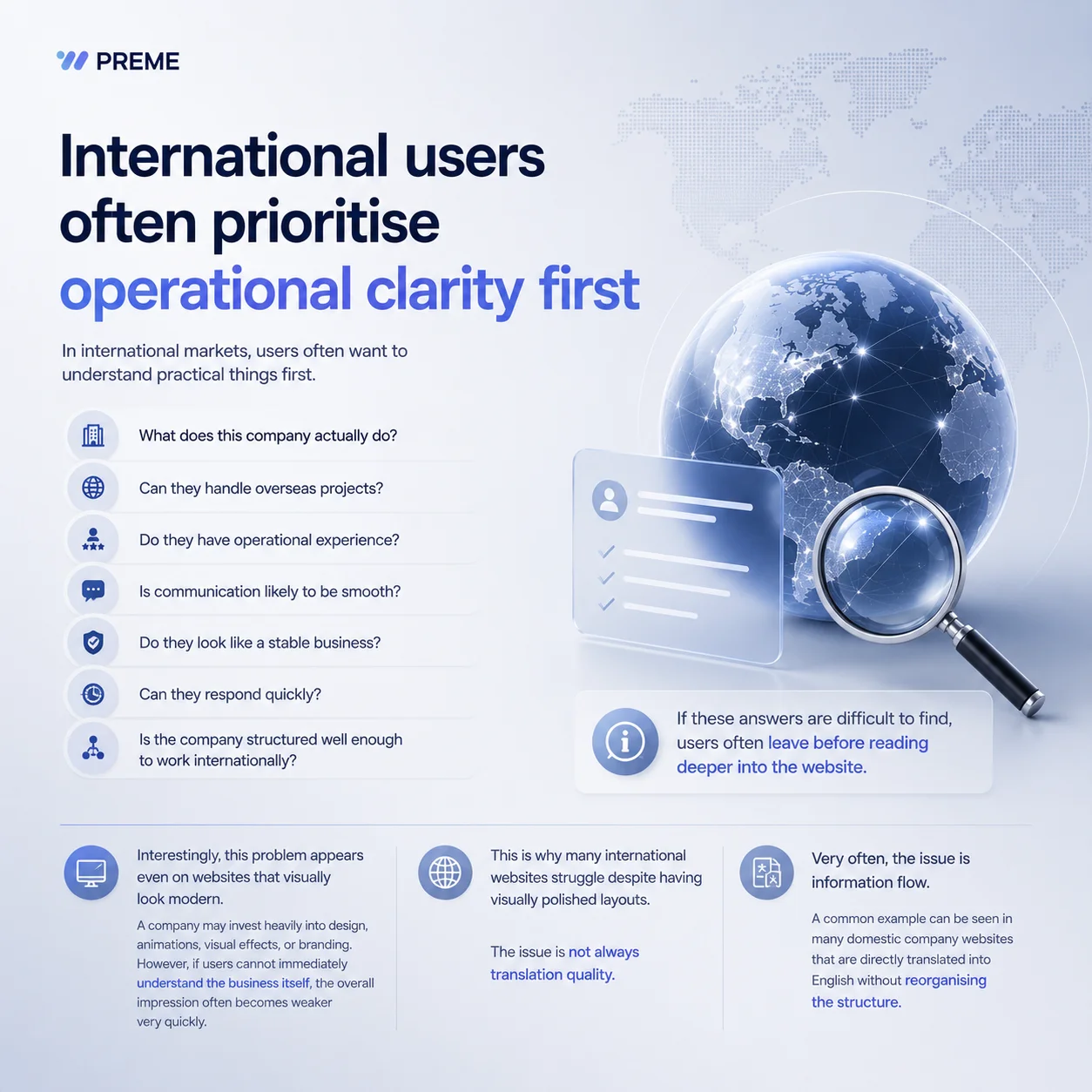
In international markets, users often want to understand practical things first.
What does this company actually do?
Can they handle overseas projects?
Do they have operational experience?
Is communication likely to be smooth?
Do they look like a stable business?
Can they respond quickly?
Is the company structured well enough to work internationally?
If these answers are difficult to find, users often leave before reading deeper into the website.
Interestingly, this problem appears even on websites that visually look modern.
A company may invest heavily into design, animations, visual effects, or branding. However, if users cannot immediately understand the business itself, the overall impression often becomes weaker very quickly.
This is why many international websites struggle despite having visually polished layouts.
The issue is not always translation
quality Very often, the issue is information flow.
A common example can be seen in many domestic company websites that are directly translated into English without reorganising the structure.
The language changes, but the experience does not.
Information order often changes how global users perceive trust
Long greetings, company introductions, history sections, or abstract branding messages are sometimes placed near the top of the page because that structure feels natural locally. International visitors, however, often expect faster access to operational information.
Especially in B2B industries, global users usually prioritise clarity over presentation.
Manufacturers, export businesses, logistics companies, industrial suppliers, technology providers, and medical equipment companies are good examples of this.
In these industries, overseas buyers frequently compare multiple suppliers within a very short period of time.
They may open several websites at once.
They may browse during work hours while handling other tasks.
They may not speak English fluently.
They may also be reviewing the company entirely through mobile devices.
Because of this, international visitors often scan first before they fully read anything.
This scanning behaviour changes how websites need to communicate.
Instead of requiring users to search deeply for important information, international websites often perform better when the core operational details are visible quickly.
For example:
Products or services
Export capability
Manufacturing systems
Inquiry process
Response structure
Certifications
International project experience
Operational scale
These types of information often build trust much faster than long introductions.
Simpler structures often create stronger international experiences
Another important factor is mobile usability.
Many international visitors first encounter websites through mobile search, email links, directories, exhibitions, or quick recommendations. If users cannot understand the company quickly on a smaller screen, exit rates increase very easily.
This is one reason international websites often require shorter understanding paths.
Complex navigation structures, oversized introduction sections, excessive text blocks, or overly decorative layouts sometimes reduce clarity rather than improving professionalism.
Interestingly, many global users associate simplicity with confidence.
When information appears organised, accessible, and operationally clear, the business itself often feels more stable and reliable.
This is why modern international websites are increasingly moving toward cleaner communication structures instead of visually overwhelming designs.
That does not mean design becomes unimportant.
Visual quality still matters.
However, the role of design changes.
Instead of focusing only on decoration, the design starts supporting understanding speed, information hierarchy, and operational clarity.
International websites eventually become operational systems
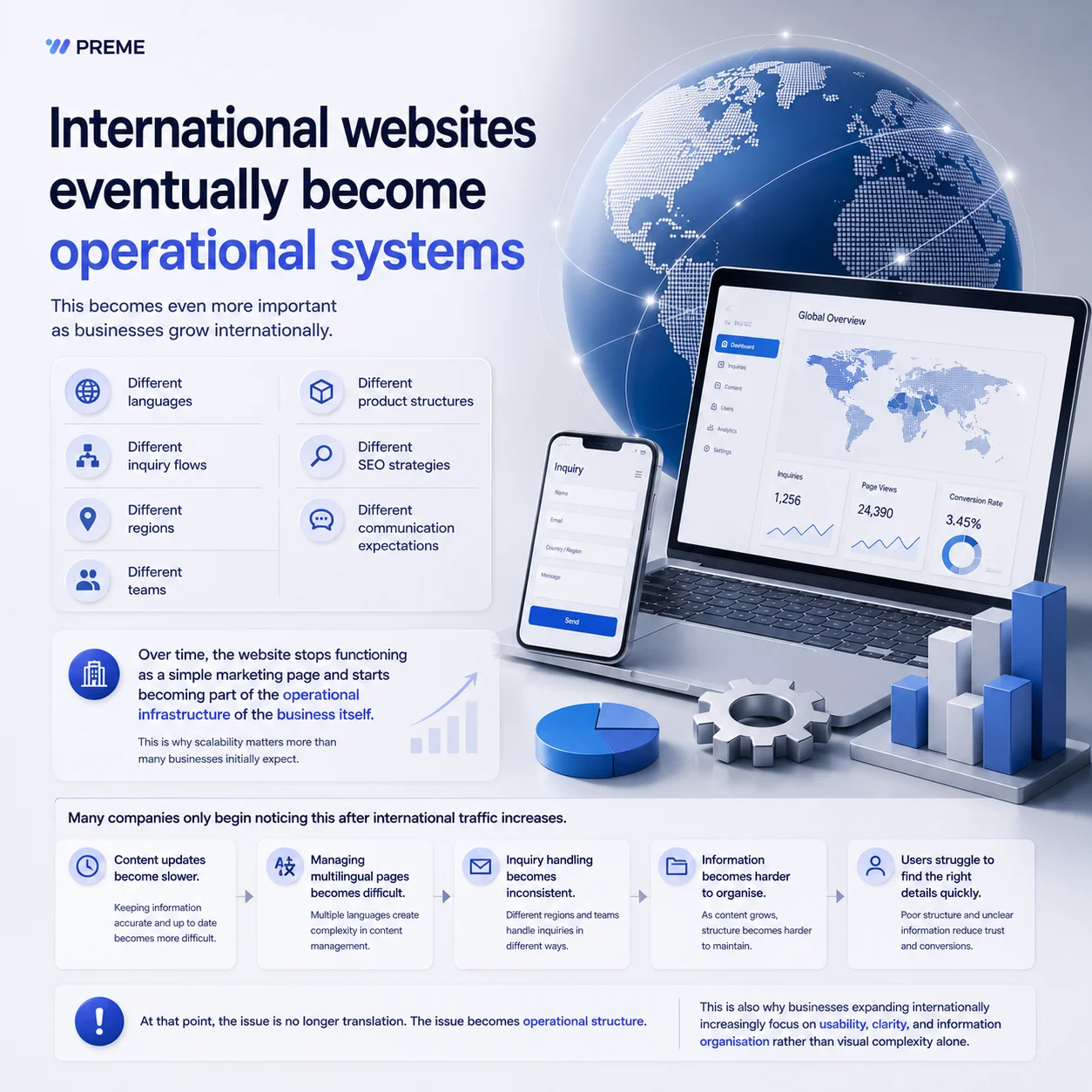
This becomes even more important as businesses grow internationally.
At first, a company may only need a simple English homepage.
Later, the website often becomes connected to much larger operational requirements.
Different languages.
Different inquiry flows.
Different regions.
Different teams.
Different product structures.
Different SEO strategies.
Different communication expectations.
Over time, the website stops functioning as a simple marketing page and starts becoming part of the operational infrastructure of the business itself.
This is why scalability matters more than many businesses initially expect.
A website that only works visually may eventually create operational limitations internally as the company grows.
Many companies only begin noticing this after international traffic increases.
Content updates become slower.
Managing multilingual pages becomes difficult.
Inquiry handling becomes inconsistent.
Information becomes harder to organise.
Users struggle to find the right details quickly.
At that point, the issue is no longer translation.
The issue becomes operational structure.
This is also why businesses expanding internationally increasingly focus on usability, clarity, and information organisation rather than visual complexity alone.
Today, international websites are expected to communicate quickly, clearly, and confidently.
Global users often scan before they read.
The businesses that understand this usually create stronger first impressions, smoother communication flow, and more scalable international website structures over time.